

























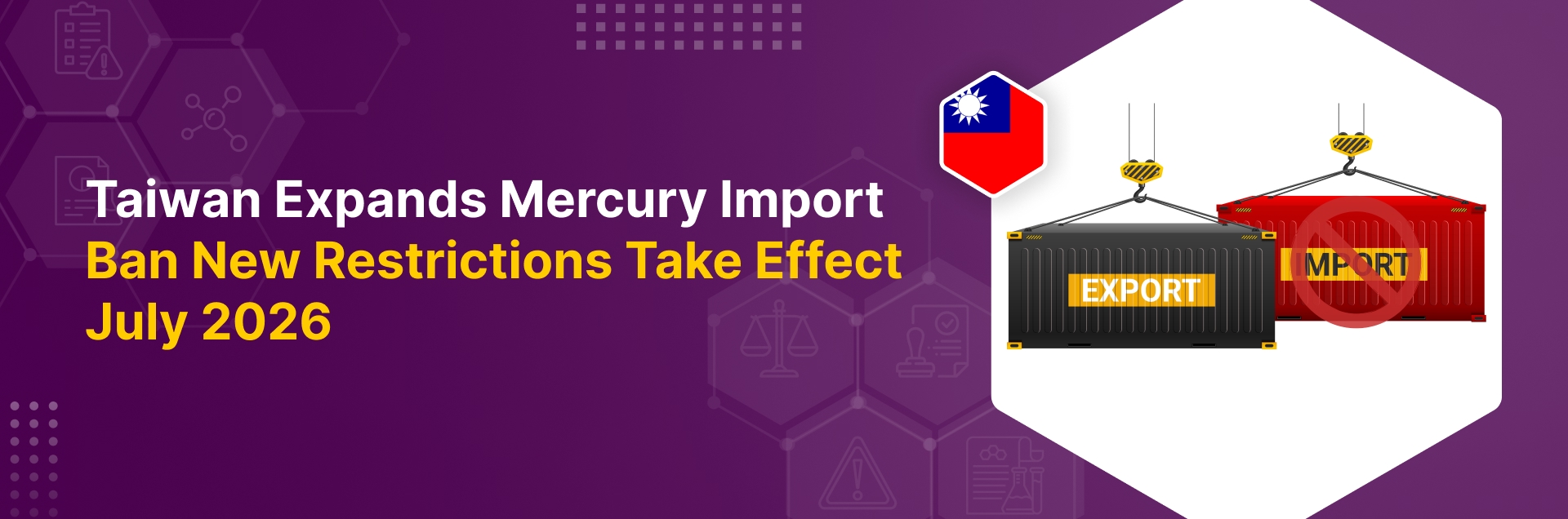
Taiwan’s Ministry of Environment (MOENV) revised the “Import Restriction on Mercury-Containing Products” on June 22, 2026, expanding the import ban to additional mercury-containing product categories and electronic measuring instruments, with phased implementation starting July 1, 2026 — aligning domestic rules with the UN Minamata Convention on Mercury.
What Happened
On June 22, 2026, Taiwan’s MOENV announced an amendment to its Import Restriction on Mercury-Containing Products, citing the need to align with international regulatory trends under the United Nations Minamata Convention on Mercury and to strengthen domestic mercury pollution prevention and source management. The revised regulation expands the list of banned mercury-containing products beyond categories already prohibited under the previous version, and explicitly adds mercury-containing electronic measuring instruments to the scope of the import ban. Implementation is phased, beginning July 1, 2026.
What’s New
- Expanded import ban: additional mercury-containing product categories added to the existing restricted list.
- Electronic measuring instruments containing mercury explicitly brought into scope of the import prohibition.
- Phased implementation starting July 1, 2026, for newly added product categories.
- Revision explicitly references the UN Minamata Convention on Mercury as the policy driver for alignment.
- Strengthens source management of mercury-containing products entering Taiwan’s market.
Key Dates & Timeline
Ministry of Environment announced the revised Import Restriction on Mercury-Containing Products.
Import ban takes effect for newly added product categories including electronic measuring instruments.
Remaining phases to take effect per the phased schedule defined in the revised restriction.
Affected Industries
Electronics and electrical equipment manufacturers and importers; measuring instrument and laboratory equipment suppliers; chemical and industrial product importers; consumer product manufacturers with mercury-containing components; companies supplying into Taiwan across industries affected by the Minamata Convention phase-out.
Who Is Affected
Importers and manufacturers of mercury-containing products sold into the Taiwan market, including businesses supplying mercury-containing electronic measuring instruments (thermometers, pressure gauges, switches, relays, and similar devices), as well as any other newly added product categories under the revised restriction.
Substances / Products in Scope
Mercury-containing products broadly (as previously restricted), plus newly added product categories and mercury-containing electronic measuring instruments explicitly added by the June 2026 amendment. The restriction applies to imports into Taiwan.
Prohibitions, Restrictions & Exemptions
Import prohibition applies to the newly listed mercury-containing product categories and electronic measuring instruments effective from the applicable phase date. The previous restriction on already-banned categories remains in force. Specific exemptions (if any) for essential uses or transitional stocks are defined in the full text of the revised restriction published by MOENV.
What Companies Should Do
- Review the full text of the revised restriction on the MOENV official notice to identify all newly added product categories.
- Audit import portfolios for mercury-containing electronic measuring instruments and any other newly listed categories.
- Coordinate with Taiwan-based importers and distributors to halt non-compliant shipments ahead of applicable phase-in dates.
- Assess mercury-free alternative technologies or substitutes for affected product lines.
- Monitor MOENV announcements for subsequent phase implementation dates and any exemption guidance.
The July 2026 expansion of Taiwan’s mercury import ban reflects accelerating Minamata Convention implementation across Asia — importers of electronic measuring instruments and other newly listed mercury-containing products face an immediate compliance cut-off and should audit shipments now; mercury-free substitution planning should be treated as urgent for any category in scope.
Reach out to our regulation experts on chemical and product regulatory compliances