























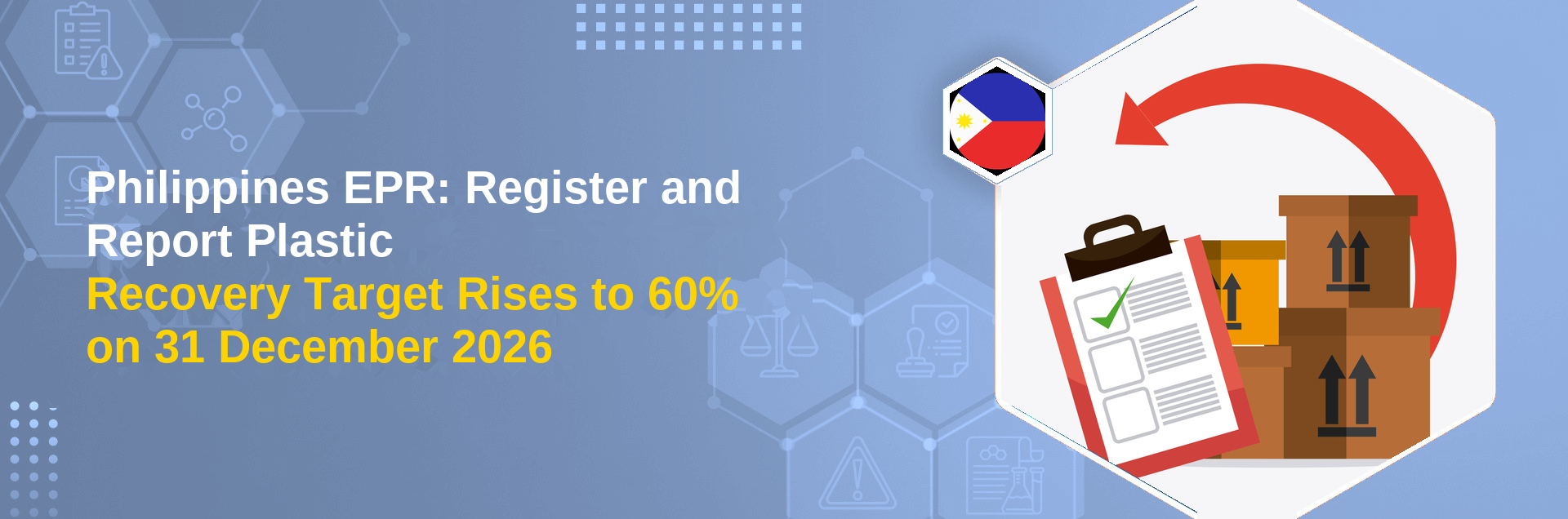
The Environmental Management Bureau operates a central EPR portal at epr.emb.gov.ph for registration and reporting under the Extended Producer Responsibility Act. Obliged enterprises, producer responsibility organisations and collectives all register through it — and the statutory recovery target rises to 60% of plastic footprint on 31 December 2026, roughly three months away.
What Happened
Republic Act No. 11898, the Extended Producer Responsibility Act of 2022, lapsed into law on 23 July 2022. It requires obliged enterprises, or the producer responsibility organisation acting for them, to submit and register their EPR programme with the National Solid Waste Management Commission through the Department of Environment and Natural Resources, and to meet plastic-footprint recovery targets that rise annually. The Environmental Management Bureau now runs a central portal for that registration and reporting at epr.emb.gov.ph, on an official emb.gov.ph subdomain, with a company-registration video and a downloadable registration manual. Sourcing note: the portal carries no launch notice, no date and no memorandum circular or Administrative Order number on its public pages, and no official DENR, EMB or NSWMC launch announcement could be retrieved. The portal’s existence and function are confirmed from the official site; a launch date is not, and the portal’s public counters currently read zero.
What’s New
- A single official portal now serves registration and reporting under RA 11898, replacing document-based submission routes.
- Three registrant types are defined on the portal: Obliged Enterprises (large enterprises generating plastic packaging waste); Producer Responsibility Organisations (established voluntarily by obliged enterprises to carry out EPR programmes); and Collectives (groups of obliged enterprises running programmes on shared infrastructure).
- The portal’s stated functions are streamlining EPR submissions, unifying waste-management reporting and tracking a Geographic Implementation Program and Roll-Out Plan, with public counters for registrations, registered plastic footprint and diversion target.
- RA 11898 registration duty: the EPR programme must be registered with the NSWMC, through the Department, within six months of the Act’s effectivity.
- Statutory recovery targets under RA 11898: 20% by 31 December 2023, 40% by 2024, 50% by 2025, 60% by 2026, 70% by 2027, and 80% by 2028 and annually thereafter.
- RA 11898 also requires annual compliance reporting and third-party independent audit of plastic-footprint data.
- MSMEs under RA 9501 are excluded, but same-brand entities whose combined assets exceed the medium-enterprise threshold are covered.
- Penalties: PHP 5-10 million for a first offence, PHP 10-15 million for a second, and PHP 15-20 million plus automatic suspension of the business permit for a third.
Key Dates & Timeline
RA 11898 lapses into law
20% plastic-footprint recovery target
50% target
60% target
70% target
80% target
No portal launch date, submission deadline or circular number appears on the portal
Affected Industries
Packaging · All manufacturing with Philippine operations · Automotive components and aftermarket · Consumer goods · Distribution
Who Is Affected
Obliged enterprises placing plastic packaging on the Philippine market; producer responsibility organisations and collectives; local subsidiaries and distributors of multinational manufacturers; packaging and compliance functions.
Standards / Products in Scope
Plastic packaging waste generated by obliged enterprises in the Philippines, and the registration, reporting and audit obligations under RA 11898.
Prohibitions, Restrictions & Requirements
No prohibition on placing packaging on the market. The obligations are to register an EPR programme, report and audit the plastic footprint, and achieve the statutory recovery targets — with escalating fines and permit suspension for repeated non-compliance.
What Companies Should Do
- Confirm whether your Philippine entity or distributor meets the obliged-enterprise threshold. This is frequently missed by manufacturers whose Philippine presence is a sales operation rather than a plant, and the same-brand aggregation rule can pull in entities that look small individually.
- If it does, register on the portal and check the public registered-entities list to confirm the record appears.
- The 60% recovery target falls due on 31 December 2026 — about three months out. Verify your recovery position against it now rather than in the new year, since diversion volumes cannot be assembled retrospectively.
- Decide between individual compliance and joining a producer responsibility organisation or collective, since the diversion targets are easier to meet at scale.
- Because the portal publishes no deadlines, confirm submission timing directly with the Environmental Management Bureau rather than relying on the site.
Philippine EPR attaches to whoever places packaging on the market, which is often a local distributor rather than the manufacturer — and the penalty for a third offence is suspension of the business permit. Establishing who in your structure is the obliged enterprise is the part that takes work; the portal itself is straightforward.
Reach out to our regulation experts on chemical and product regulatory compliances