


























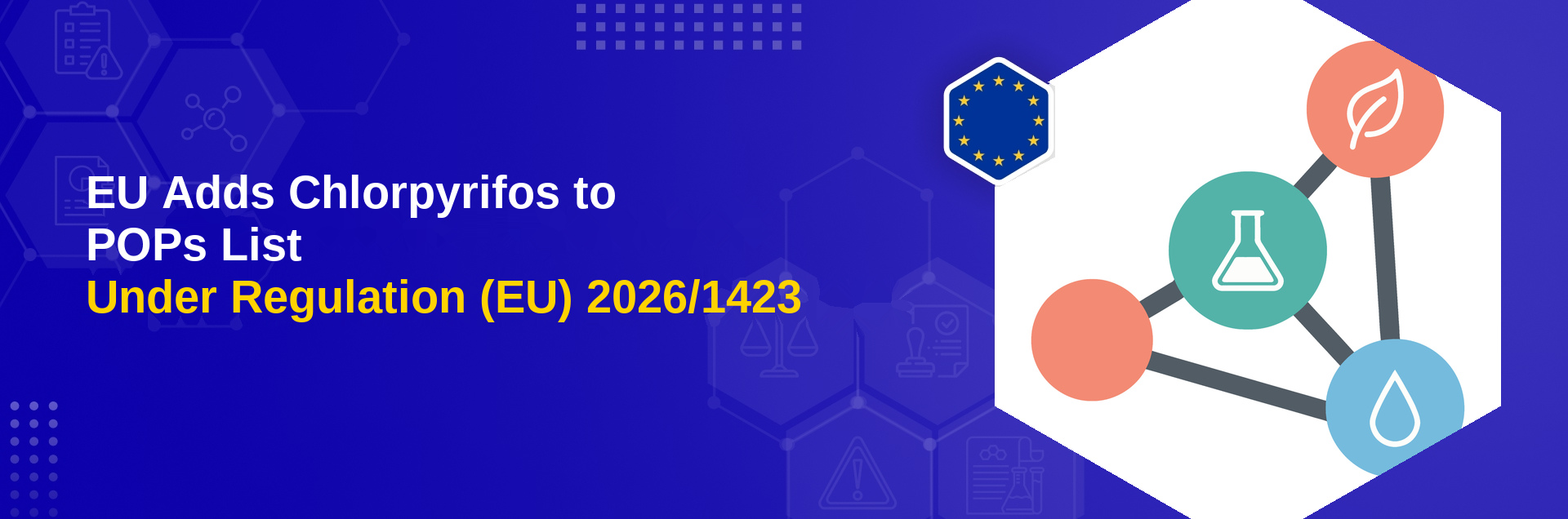
Chlorpyrifos has been added to Annex I of the EU POPs Regulation and, unlike the Stockholm Convention listing it implements, the EU has taken no specific exemptions. From 30 September 2026 the substance may not be placed on the market in substances, mixtures or articles above an unintentional trace limit of 0.01 mg/kg.
What Happened
Commission Delegated Regulation (EU) 2026/1423 of 30 June 2026, amending Regulation (EU) 2019/1021 as regards chlorpyrifos, was published in the Official Journal on 10 September 2026 and enters into force on the twentieth day following publication. It implements the decision of the Conference of the Parties to the Stockholm Convention, at its twelfth meeting from 28 April to 9 May 2025, to amend Annex A of the Convention to include chlorpyrifos with specific exemptions. The Union supported that inclusion, but the EU act lists the substance in Part A of Annex I without taking any of the specific exemptions available at Convention level. Recital 6 records that a limit value should be set to reinforce enforcement, and the act fixes that value at 0.01 mg/kg. The Regulation is binding in its entirety and directly applicable in all Member States, with no national transposition step.
What’s New
- Chlorpyrifos (CAS 2921-88-2, EC 220-864-4) is added to Part A of Annex I to Regulation (EU) 2019/1021, the EU POPs Regulation.
- No specific exemptions: the Stockholm Convention listing allows them, and the EU has declined to take any — the EU position is stricter than the international baseline.
- Unintentional trace contaminant limit set at 0.01 mg/kg (0.000001% by weight); Article 4(1), point (b) applies at or below that concentration.
- The prohibition reaches substances, mixtures and articles, which is what brings it into scope for manufactured goods rather than only for pesticide formulations.
- This act amends Part A of Annex I only — it does not set Annex IV or Annex V waste concentration limits, which would come separately.
- Directly applicable in all Member States on entry into force; no transposition and no transition period in the act.
Key Dates & Timeline
Stockholm Convention COP-12 amends Annex A to include chlorpyrifos with specific exemptions
Commission Delegated Regulation (EU) 2026/1423 adopted
Published in the Official Journal of the European Union
Enters into force, twentieth day after publication
Annex IV and Annex V waste concentration limits for chlorpyrifos
Affected Industries
All · Natural fibre and bio-based materials · Textiles and leather interiors · Natural rubber · Wood and transport packaging · Chemicals · Agricultural-derived feedstocks
Who Is Affected
Manufacturers, importers and distributors placing substances, mixtures or articles on the EU market; buyers of natural-fibre, leather, natural rubber and bio-based components; packaging and logistics functions responsible for wood pallets and crating; restricted-substances and IMDS data teams.
Standards / Products in Scope
Chlorpyrifos in substances, mixtures and articles placed on the EU market. For an automotive bill of materials the realistic exposure is not a deliberate ingredient but a residue: natural fibres such as kenaf, jute, flax and cotton used in interior trim, leather, natural rubber, bio-based polymers, and insect-treated wood packaging and pallets.
Prohibitions, Restrictions & Requirements
Manufacture, placing on the market and use of chlorpyrifos are prohibited, with no specific exemptions taken by the EU. The only tolerance is for chlorpyrifos present as an unintentional trace contaminant at or below 0.01 mg/kg, to which Article 4(1)(b) applies.
What Companies Should Do
- Treat this as a natural-materials and packaging question rather than a chemicals one. Chlorpyrifos will not appear in a chemical specification; it appears as a crop-protection residue in plant-derived inputs, so the request goes to those suppliers.
- Ask suppliers of natural fibre trim, leather, natural rubber and bio-based polymers to confirm compliance against the 0.01 mg/kg trace limit, and note that a standard REACH declaration will not answer this.
- Check wood packaging and pallets, including those arriving with imported components — insect treatment is the plausible route by which chlorpyrifos reaches your inbound logistics.
- Add chlorpyrifos to your restricted-substances list and watch for it flowing into GADSL and IEC 62474 declarable lists; POPs listings routinely follow that path.
- Note the interaction with the PIC amendment elsewhere in this issue: chlorpyrifos is simultaneously proposed for the Annex V export ban under Regulation (EU) No 649/2012, so both import-side and export-side controls are closing in the same quarter.
The substance itself is an insecticide no vehicle programme would specify, which is exactly why this is easy to miss. The POPs Regulation reaches articles, the EU declined every exemption the Convention allowed, and 0.01 mg/kg is a residue threshold — so the exposure sits with plant-derived materials and wood packaging, where nobody is currently asking the question.
Reference: EUR-Lex — Commission Delegated Regulation (EU) 2026/1423 of 30 June 2026 amending Regulation (EU) 2019/1021 as regards chlorpyrifos | EUR-Lex — full text as published in the Official Journal, 10 September 2026 | EUR-Lex — Regulation (EU) 2019/1021 on persistent organic pollutants (consolidated) | Stockholm Convention — Conference of the Parties, twelfth meeting (COP-12)
Reach out to our regulation experts on chemical and product regulatory compliances