





























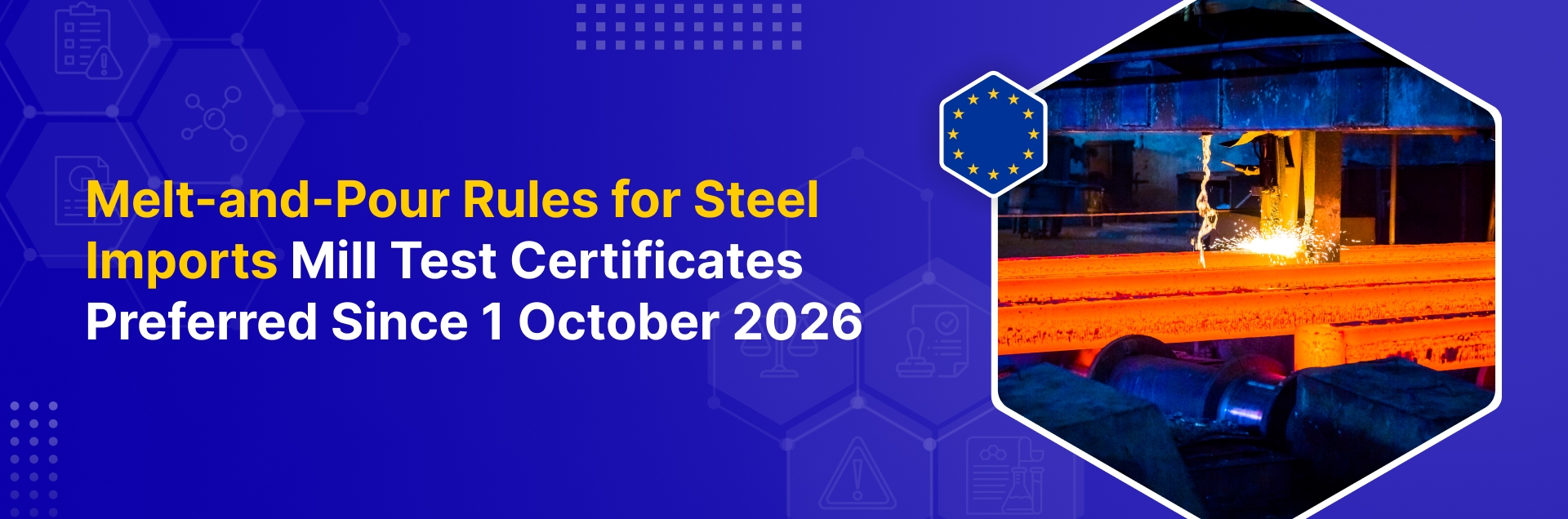
Commission Implementing Regulation (EU) 2026/1963 of 28 August 2026 sets out the melt-and-pour evidence importers must provide to prove the country where steel was melted and poured. The rules apply from 1 October 2026.
What Melt-and-Pour Evidence Importers Need
From 1 October 2026, importers of steel products subject to the EU steel safeguard measures must declare the melt-and-pour country on the customs import declaration. The aim is better traceability and support for EU efforts against trade diversion and global steel overcapacity.
The preferred evidence is a Mill Test Certificate showing the melt-and-pour country and the heat number. If it is unavailable or incomplete, customs authorities may temporarily accept other documents.
What’s New
- Melt-and-pour country must be declared on the customs import declaration from 1 October 2026.
- A Mill Test Certificate showing the melt-and-pour country and heat number is the preferred proof.
- Invoices, delivery notes, supplier declarations, customs documents or commercial correspondence may be accepted for a transitional period if the certificate is unavailable or incomplete.
- From 1 October 2027, those alternative documents will only support a Mill Test Certificate and will no longer serve as standalone proof.
Key Dates & Timeline
Who and What Is in Scope
Industries: Light duty vehicles · Heavy duty vehicles · Automotive components · Fasteners and metal formed parts · Metals and steel
Who is affected: Importers of steel products covered by the EU steel safeguard measures, customs brokers, and the steel suppliers and traders who must provide mill test certificates for each heat.
Products and standards in scope: Steel products subject to the EU steel safeguard measures.
Requirements and restrictions: Declare the melt-and-pour country at import and hold supporting evidence. No numeric threshold; the Mill Test Certificate with melt-and-pour country and heat number is the preferred proof.
What Companies Should Do
- Ask steel suppliers for mill test certificates that show melt-and-pour country and heat number on every consignment.
- Brief customs brokers on the new declaration requirement.
- Plan to rely on certificates rather than commercial documents before 1 October 2027.
Certificate-level traceability is now a customs requirement for safeguarded steel. Importers should get mill test certificates in place before the 2027 end of the transitional document rules.
Related: CBAM compliance services | EU Parliament Position on CBAM Changes
EUR-Lex — Commission Implementing Regulation (EU) 2026/1963 — https://eur-lex.europa.eu/eli/reg_impl/2026/1963/oj
Reach out to our regulation experts on chemical and product regulatory compliances