






















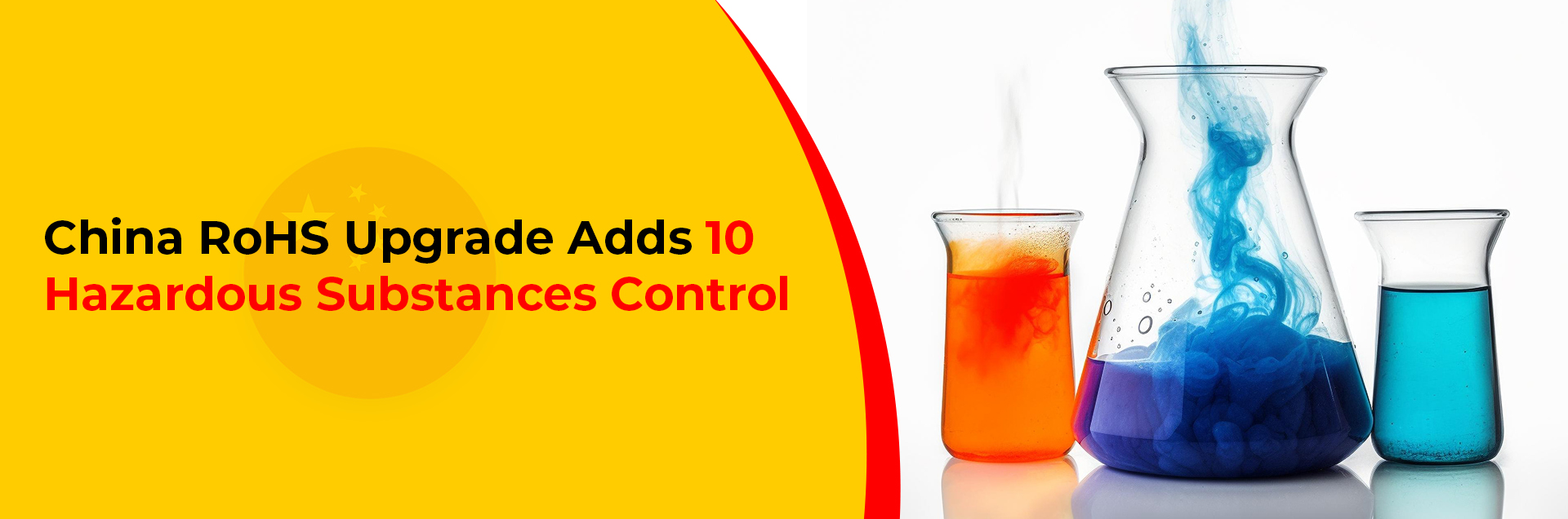
China has officially upgraded its Restriction of Hazardous Substances (China RoHS) framework, expanding regulatory control from six to ten hazardous substances in electrical and electronic products. The revision strengthens chemical management requirements and brings China RoHS further in line with the EU RoHS Directive.
The update was announced through Amendment No. 1 to GB/T 26572-2011, with key provisions taking effect from January 1, 2026.
Regulatory Milestones
- April 1, 2025
New marking requirements under SJ/T 11364-2024 became effective. - January 1, 2026
Amendment No. 1 to GB/T 26572-2011 entered into force, officially expanding the hazardous substance control list. - August 1, 2027
The mandatory national standard GB 26572-2025 will take effect, replacing GB/T 26572-2011.
Expanded China RoHS Hazardous Substance List
Under the upgraded China RoHS framework, electrical and electronic products must comply with concentration limits for the following 10 hazardous substances in homogeneous materials:
| Substance | Limit |
|---|---|
| Lead (Pb) | ≤ 0.1% |
| Mercury (Hg) | ≤ 0.1% |
| Cadmium (Cd) | ≤ 0.01% |
| Hexavalent Chromium [Cr(VI)] | ≤ 0.1% |
| Polybrominated Biphenyls (PBBs) | ≤ 0.1% |
| Polybrominated Diphenyl Ethers (PBDEs) | ≤ 0.1% |
| Bis(2-ethylhexyl) phthalate (DEHP) | ≤ 0.1% |
| Benzyl butyl phthalate (BBP) | ≤ 0.1% |
| Dibutyl phthalate (DBP) | ≤ 0.1% |
| Diisobutyl phthalate (DIBP) | ≤ 0.1% |
The addition of four phthalates (DEHP, BBP, DBP, and DIBP) marks a major expansion of China RoHS substance control.
Updated Testing Standards
With the amendment, the original reference to GB/T 26125 has been replaced by the GB/T 39560 series, which aligns testing methods with updated international standards for hazardous substance determination.
New Marking and Labelling Requirements
Under SJ/T 11364-2024, manufacturers must update hazardous substance disclosure tables to reflect all 10 regulated substances. Products placed on the Chinese market must display compliant markings starting from January 1, 2026.
Conformity Assessment Transition Rules
For products already listed in the Compliance Management Catalog:
- Existing conformity assessments based on six substances must be updated to cover all ten substances
- The transition period runs from January 1, 2026, to January 1, 2027
- Products failing to update assessments may not be manufactured, imported, or sold in China after the deadline
Alignment With EU RoHS and Industry Impact
This regulatory upgrade significantly improves alignment between China RoHS and EU RoHS, reducing compliance gaps for multinational manufacturers.
Implications for industry include:
- Expanded chemical compliance scope
- Mandatory updates to testing, documentation, and labels
- Re-assessment of supply chains for newly added phthalates
- Increased compliance obligations ahead of GB 26572-2025 enforcement
Reach out to our regulation experts on chemical and product regulatory compliances