


































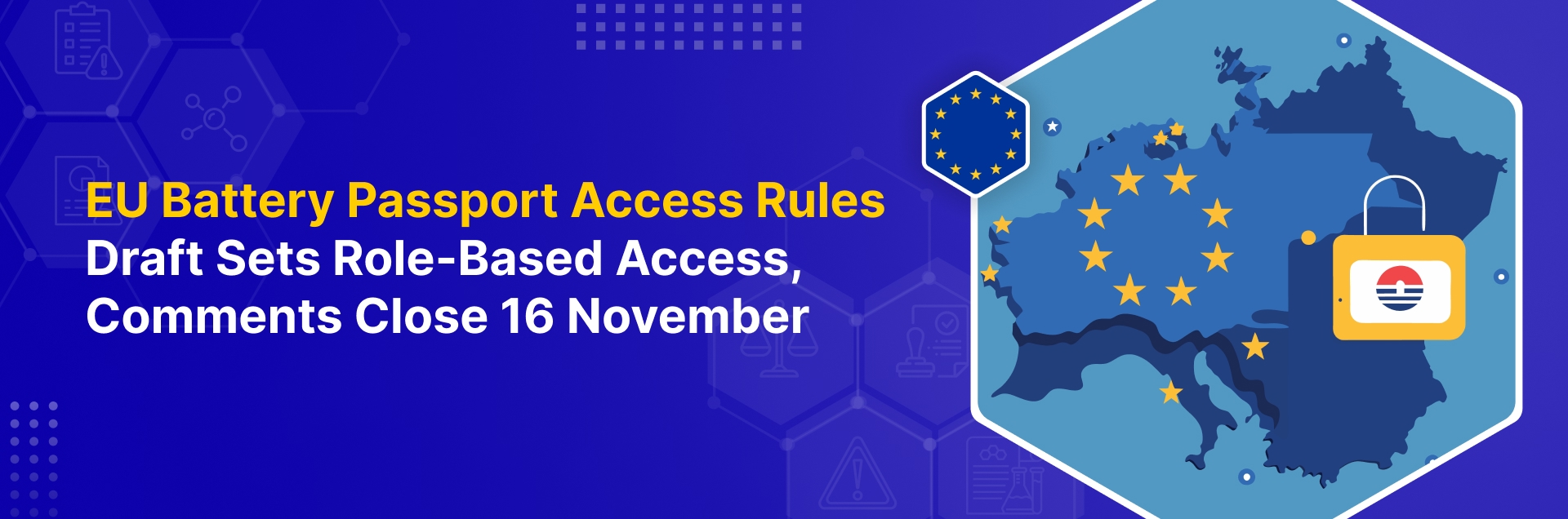
The European Commission published draft battery passport access rules, and feedback closed on 16 November 2026. The battery passport is a digital record that holds data about each battery. The draft sets who can see restricted data in the passport. The passport itself starts later, on 18 February 2027.
What Happened
A draft implementing regulation on access to the battery passport was open for feedback until 16 November 2026. The rules are still a draft. The Commission plans to adopt them in the fourth quarter of 2026.
The draft gives access by role instead of access to the whole passport. As a result, not everyone sees all the data. Repairers and recyclers see the data for their role. So do remanufacturers and repurposers. Waste treatment operators and vocational training centres can do the same. Battery purchasers can also see set data. Examples are component part numbers, spare part sources and the condition of an individual battery.
Eligible users may download restricted data and use it for repair, reuse and recycling work. However, they generally cannot publish it or pass it on. Instead, they may keep it only as long as they need it. Exceptions allow sharing with emergency services, poison centres and authorities. The company that placed the battery on the market can approve other sharing.
Safety data is the exception. Eligible users, such as end-of-life vehicle and waste electrical and electronic equipment (WEEE) sites, can use, share and publish it freely.
What’s New
- Role-based access replaces blanket access to the full passport.
- Restricted data can be used only for the permitted purposes.
- Users may keep restricted data only as long as they need it.
- Other sharing needs permission from the company that placed the battery on the market.
- Eligible users can use and share safety information without limits.
- Adoption is planned for Q4 2026.
Key Dates & Timeline
Who and What Is in Scope
Industries: Light duty vehicles · Heavy duty vehicles · Battery and energy storage · Recycling and remanufacturing · Software providers
Who is affected: Battery makers, passport system developers, repairers, remanufacturers, recyclers and battery buyers.
Products and standards in scope: Restricted data in the battery passport for EV batteries, light means of transport batteries and industrial batteries above 2 kWh.
Requirements and restrictions: The draft sets no fine. System developers must build access controls that separate public data from role-restricted data. Users must follow the use and sharing limits.
What Companies Should Do
- First, check which access category your company falls into.
- Then review how your passport system will separate public and restricted data.
- Also prepare data-sharing terms for your partners.
- Finally, watch for the final act, which the Commission plans to adopt in Q4 2026.
Feedback has closed, but the rules are not final. Check your role and your system design now.
Related: EU Advances Digital Product Passport Rule
European Commission — Digital product passport for batteries — https://single-market-economy.ec.europa.eu/single-market/digital-product-passport/batteries_en
EUR-Lex — Batteries Regulation (EU) 2023/1542 — https://eur-lex.europa.eu/eli/reg/2023/1542/oj
Reach out to our regulation experts on chemical and product regulatory compliances