


























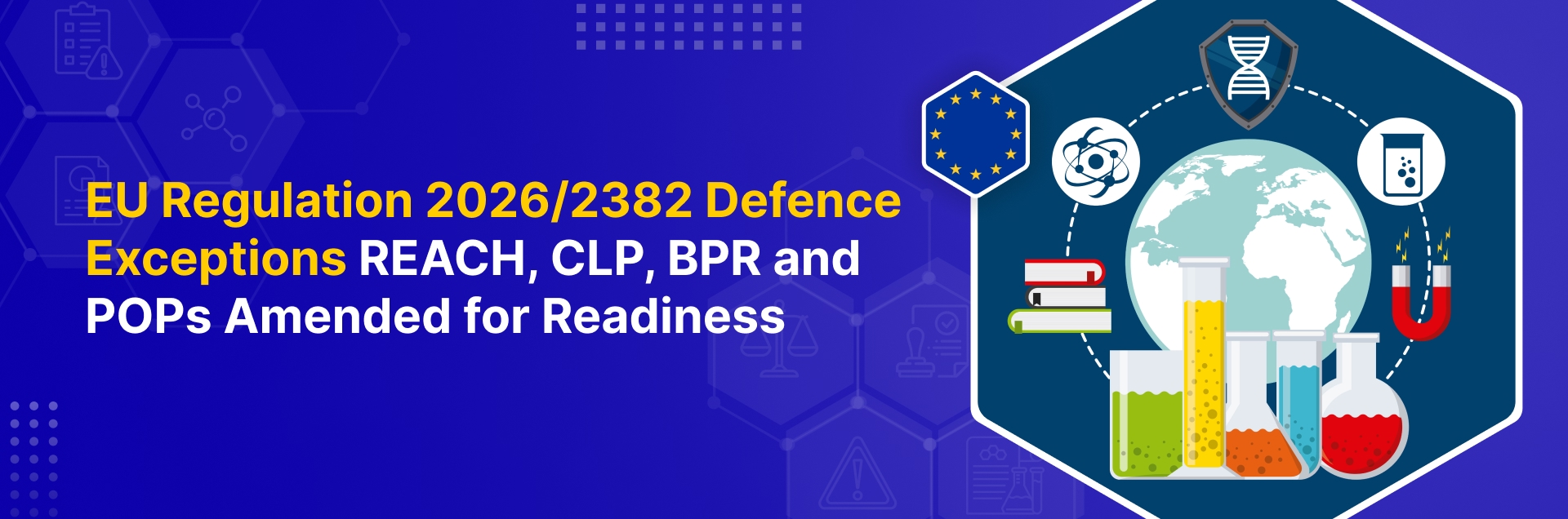
Regulation (EU) 2026/2382 adds defence readiness exceptions to four chemicals laws. These are REACH (Registration, Evaluation, Authorisation and Restriction of Chemicals), CLP (Classification, Labelling and Packaging), the Biocidal Products Regulation (BPR) and the POPs Regulation on persistent organic pollutants. The regulation appeared in the Official Journal on 3 November 2026 and entered into force on 23 November 2026.
What Happened
Its date is 21 October 2026. The Official Journal published it on 3 November 2026. It entered into force on the twentieth day after publication, which was 23 November 2026.
It changes several laws at once. First, REACH Article 2(3) lets Member States exempt substances, mixtures and articles where necessary in the interests of defence. Next, CLP Article 1(4) gets a matching exception. Also, BPR Article 2(8) does the same for biocidal products.
The POPs Regulation changes too. A new Article 3(4a) tells the Commission and Member States to give due weight to defence readiness when they collect socio-economic data. It also adds a reporting exception to Article 13(1). Member States can use it to protect sensitive defence information. In addition, the act amends the European Defence Fund rules.
What’s New
- REACH Article 2(3): Member States can exempt defence uses.
- CLP Article 1(4): a matching defence exception.
- BPR Article 2(8): a matching defence exception.
- POPs Regulation: due weight for defence readiness in Article 3(4a), and a reporting exception in Article 13(1).
- The European Defence Fund rules are amended as well.
Key Dates & Timeline
Who and What Is in Scope
Industries: Defence · Aerospace · Automotive components (dual-use) · Chemicals · Electronics
Who is affected: Defence contractors, their chemical suppliers and compliance teams. Dual-use suppliers, including automotive makers with defence lines, are affected as well.
Products and standards in scope: Chemicals used for defence purposes under REACH, CLP, the BPR and the POPs Regulation.
Requirements and restrictions: The exceptions are optional for Member States. They apply only where necessary in the interests of defence. Civil uses still follow the normal rules.
What Companies Should Do
- Identify products and substances with defence uses.
- Check the national rules in each Member State where you sell.
- Keep records that separate defence and civil uses.
- Watch for national use of the exceptions now that the regulation applies.
The act widens defence exceptions, but each Member State decides how to use them. Civil supply chains see no change.
EUR-Lex — Regulation (EU) 2026/2382 — https://eur-lex.europa.eu/eli/reg/2026/2382/oj
Reach out to our regulation experts on chemical and product regulatory compliances