


































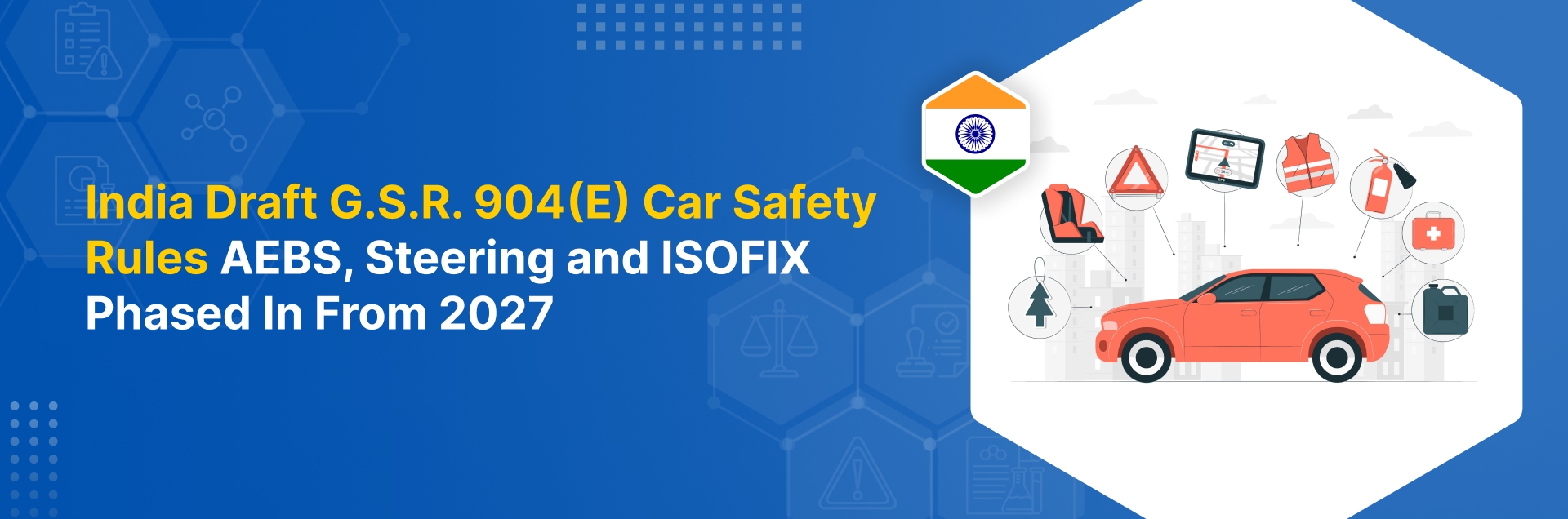
India’s Ministry of Road Transport and Highways (MoRTH) has published draft AEBS rules for M1 cars. AEBS means advanced emergency braking systems, which brake the car automatically in an emergency. M1 cars are passenger cars with up to eight seats, besides the driver. Draft G.S.R. 904(E), a General Statutory Rules notification, also covers steering, ISOFIX (child seat anchorages) and driver drowsiness warning. Phase-in dates run from 2027 to 2032. Meanwhile, objections closed about 21 November 2026.
What Happened
MoRTH dated the draft notification 19 October 2026. It was issued on 21 October and published on 22 October 2026. The draft also amends the Central Motor Vehicles Rules, 1989. Because the public has 30 days to send objections, the deadline fell about 21 November 2026.
Rule 96 covers AEBS under AIS-185, an Automotive Industry Standard (AIS) of India. From 1 October 2028, M1 and N1 vehicles that carry AEBS must comply with the standard. N1 vehicles are light goods vehicles. First, AEBS becomes mandatory on new M1 models from 1 October 2030. It then applies to all M1 vehicles from 1 October 2032. N1 vehicles need it only if the system is fitted.
Rule 98 covers steering. Next, steering effort rules under AIS-193 apply from 1 October 2027. Also, the automatically commanded steering function (ACSF) and emergency lane keeping systems (ELKS) under AIS-191 Part 1 apply to transport-registered M1 vehicles from 1 October 2029.
Rule 125 covers luggage retention under Indian Standard IS 15546:2005. It applies from 1 April 2028 for new models and 1 October 2028 for all models. It also covers ISOFIX child seat anchorages under AIS-182, from 1 October 2027 for new models and 1 October 2028 for all models. Finally, Rule 125-Q covers driver drowsiness and attention warning (DDAW) under AIS-184. Fitted systems must comply from 1 October 2027, and transport M1 vehicles must carry DDAW from 1 October 2029.
What’s New
- AEBS (AIS-185): mandatory on new M1 models from October 2030 and on all M1 vehicles from October 2032.
- Steering effort (AIS-193): from October 2027.
- ACSF and ELKS (AIS-191 Part 1): transport M1 vehicles from October 2029.
- ISOFIX (AIS-182): new models from October 2027 and all models from October 2028.
- Luggage retention (IS 15546:2005): new models from April 2028 and all models from October 2028.
- DDAW (AIS-184): fitted systems from October 2027, and mandatory for transport M1 vehicles from October 2029.
Key Dates & Timeline
Who and What Is in Scope
Industries: Light duty vehicles · Automotive components · Safety systems · Sensors and electronics
Who is affected: M1 car makers, importers and Tier 1 suppliers of braking, steering, seat and driver monitoring systems. Test labs and homologation teams are affected too.
Products and standards in scope: M1 passenger cars. N1 light goods vehicles are in scope only for AEBS where the system is fitted.
Requirements and restrictions: Vehicles must meet the listed AIS standards by the phase-in dates. New models come first, followed by all vehicles.
What Companies Should Do
- Map your M1 range against each phase-in date.
- Check sensor and software readiness for AEBS and DDAW.
- Plan AIS test slots with your test agencies.
- Check whether MoRTH has published the final notification, because the objection period has closed.
The first dates start in 2027, so the lead time is short. The objection period has closed. Verify the final Gazette text.
Gazette of India (eGazette) — G.S.R. 904(E), draft Central Motor Vehicles (Amendment) Rules, 2026 — https://egazette.gov.in/WriteReadData/2026/277340.pdf
Reach out to our regulation experts on chemical and product regulatory compliances