





































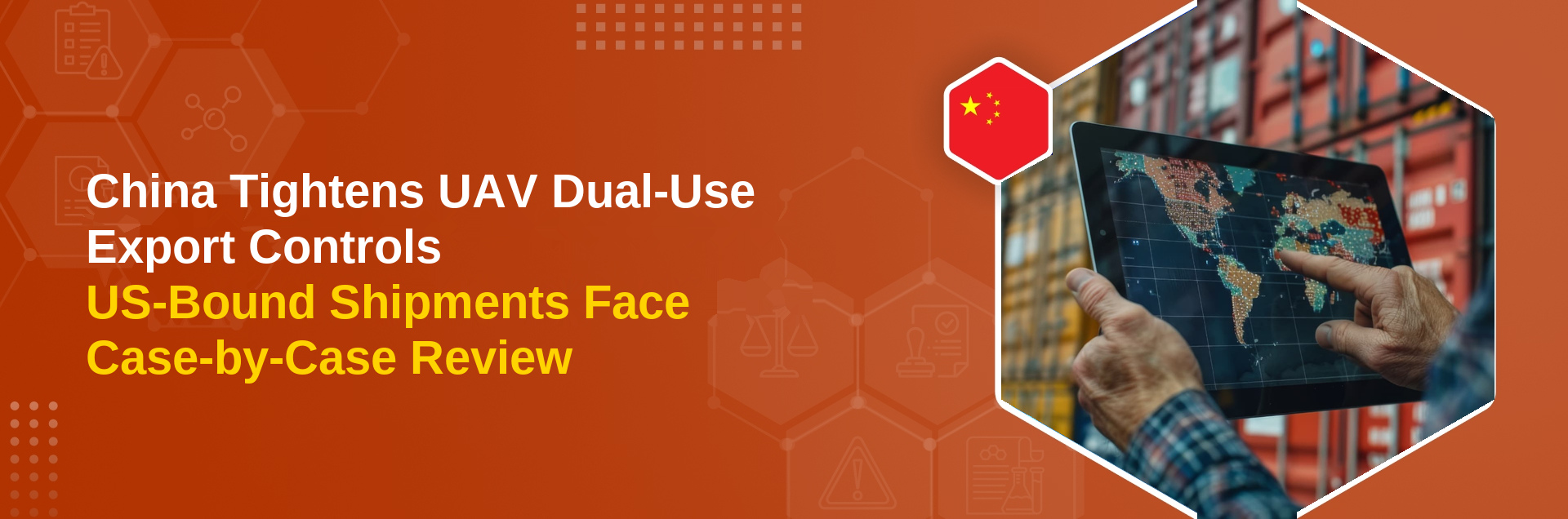
China’s Ministry of Commerce has announced strengthened export controls on unmanned aerial vehicles, their key components and related technology destined for the United States. Exports now face strict case-by-case review, and licensing facilitation measures no longer apply.
What Happened
Ministry of Commerce Announcement No. 34 of 2026, 公布加强无人机相关两用物项对美国出口管制 (Announcement on Strengthening Export Control of Unmanned Aerial Vehicle-Related Dual-Use Items to the United States), was published and implemented on 5 August 2026. It modifies export control procedures for items on China’s Dual-Use Items Export Control List where those items are destined for the United States, invoking the Export Control Law and the Regulations on Export Control of Dual-Use Items on national security and non-proliferation grounds.
What’s New
- Items affected are unmanned aerial vehicles, their key components and related technology destined for the United States.
- Exports must undergo strict case-by-case review — 逐案从严审核 — with licensing facilitation measures expressly not applicable (不适用许可便利措施).
- Implemented on the date of publication, with no transition period.
Key Dates & Timeline
Announcement No. 34 of 2026 published and implemented
Affected Industries
Unmanned aerial systems · Defence and aerospace · Electrical and electronic equipment · Sensors, motors and control systems · Batteries
Who Is Affected
Exporters in China of UAVs, UAV components and related technology; US importers of those items; purchasing and trade compliance functions sourcing motors, flight controllers, sensors, cameras, gimbals and battery systems from China.
Standards / Products in Scope
Dual-use items on China’s Export Control List relating to unmanned aerial vehicles, their key components and associated technology, where the destination is the United States.
Prohibitions, Restrictions & Requirements
Not a ban. Licences remain available but are subject to strict case-by-case review, and the facilitation measures that ordinarily speed licensing are withdrawn for this category and destination — which in practice means longer, less predictable lead times.
What Companies Should Do
- If your business touches UAV or drone-adjacent components sourced from China for US delivery, re-plan lead times on the assumption that licences take materially longer.
- Identify dual-use components shared between UAV and automotive applications — motors, controllers, sensors and battery packs — and check whether your part numbers fall within the controlled scope.
- Ask Chinese suppliers to confirm in writing whether their export licences for US-bound shipments are affected, rather than assuming continuity.
The direct scope is narrow, but the components involved are shared with automotive electronics and electrification. The lesson for supply chain planning is that Chinese export licensing is now an active variable in delivery schedules, not a background formality.
Reach out to our regulation experts on chemical and product regulatory compliances