

























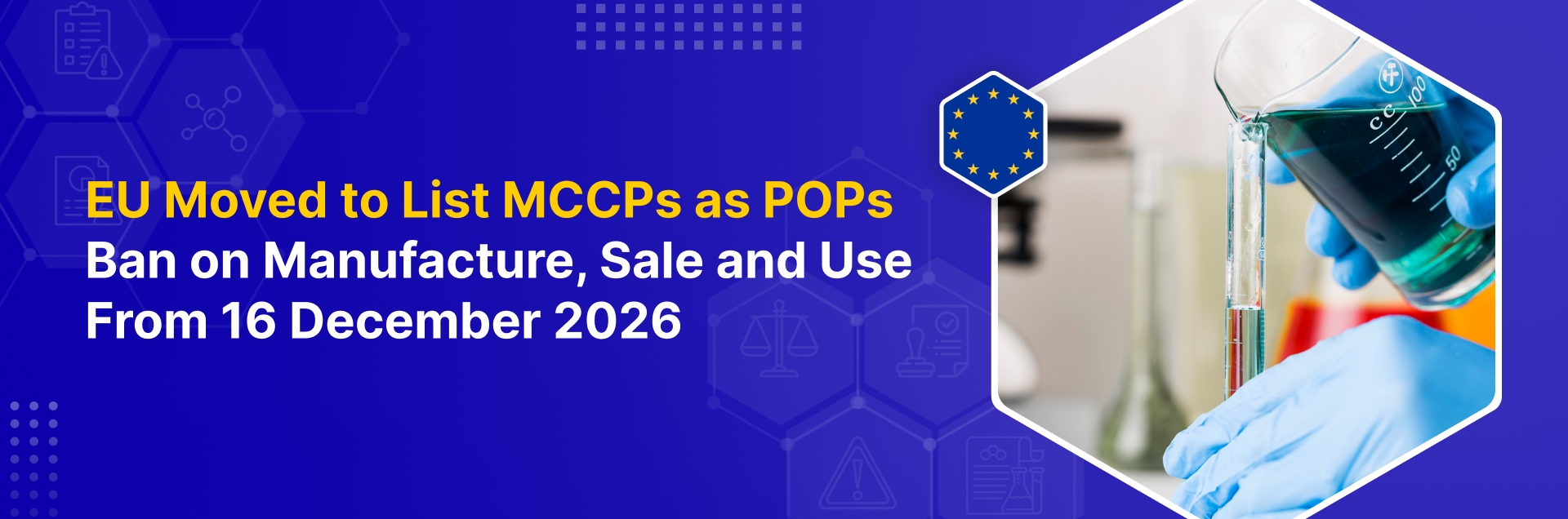
The European Commission is integrating medium-chain chlorinated paraffins (MCCPs) into Part A of Annex I to the EU POPs Regulation, banning their manufacture, placing on the market and use. The listing applies from 16 December 2026, with a general 0.1% trace limit and time-limited derogations.
What the EU Ban on MCCPs Covers
The act adds MCCPs to Annex I of Regulation (EU) 2019/1021, following the Stockholm Convention listing agreed in 2025. It enters into force on the twentieth day after publication in the Official Journal and applies from 16 December 2026, matching the date the Convention amendment takes effect for the EU.
MCCPs have been a REACH substance of very high concern since 2021 and are used in metalworking fluids, plasticisers, sealants and flexible PVC. The POPs listing replaces case-by-case REACH controls with a full ban and narrow derogations.
What’s New
- General unintentional trace contaminant limit of 0.1% by weight in substances, mixtures and articles; a 2% limit for cable-recycling material applies for two years, only for road furniture and blocks supporting fences.
- Two-year derogations: flexible PVC in construction wires and cables; polysulfide sealant and one-component polyurethane foam for doors and windows; waterproof and anti-corrosion coatings.
- Five-year derogations: recycling of one-component foam and use of the recycled prepolymer in new cans; recovered material used in door and window sealing.
- Spare parts: MCCP-containing polymers and rubbers may continue to be used in spare parts and repairs until the end of the product’s service life or 31 December 2041, whichever is earlier.
- Articles in use when an exemption expires may stay in use, and spare parts already in the EU on or before expiry may still be placed on the market.
- Exemptions for metalworking fluids, aerospace and defence, and medical and in-vitro diagnostic devices are time-limited; check the final Annex I entry for exact end dates.
Key Dates & Timeline
Who and What Is in Scope
Industries: Automotive components · Plastics and rubber · Wire and cable · Coatings and adhesives · Metalworking
Who is affected: Manufacturers, importers and formulators of MCCP-containing PVC, cables, rubber, sealants, adhesives and metalworking fluids; automotive suppliers of wiring, seals and spare parts.
Products and standards in scope: MCCPs: substances or mixtures containing linear C14–C17 chloroalkanes as defined in Annex I Part A, in substances, mixtures and articles.
Requirements and restrictions: Ban on manufacture, placing on the market and use from 16 December 2026, with a 0.1% trace limit and the derogations above. Products above the limit cannot be supplied in the EU unless a derogation applies.
What Companies Should Do
- Screen flexible PVC compounds, cables, rubber parts, sealants, adhesives and metalworking fluids for MCCP content against the 0.1% limit.
- Map any use you rely on to the derogation list and its end date, especially for spare parts.
- Request MCCP declarations from suppliers and align IMDS entries; IMDS Release 15.4 renames the MCCP substance group to “Potentially MCCP containing substances”.
- Plan substitution for uses that only benefit from short derogations.
MCCPs move from a REACH watch-list substance to a POPs ban on 16 December 2026. Suppliers of PVC, cables, rubber and sealants should confirm MCCP content now and plan around the short derogation windows.
Related: New MCCP-linked substances flagged | Long-Chain PFCAs Added to POPs Regulation
Council of the EU — Delegated Regulation on MCCPs under the POPs Regulation (ST 13064/2026) — https://data.consilium.europa.eu/doc/document/ST-13064-2026-INIT/en/pdf
Reach out to our regulation experts on chemical and product regulatory compliances