






























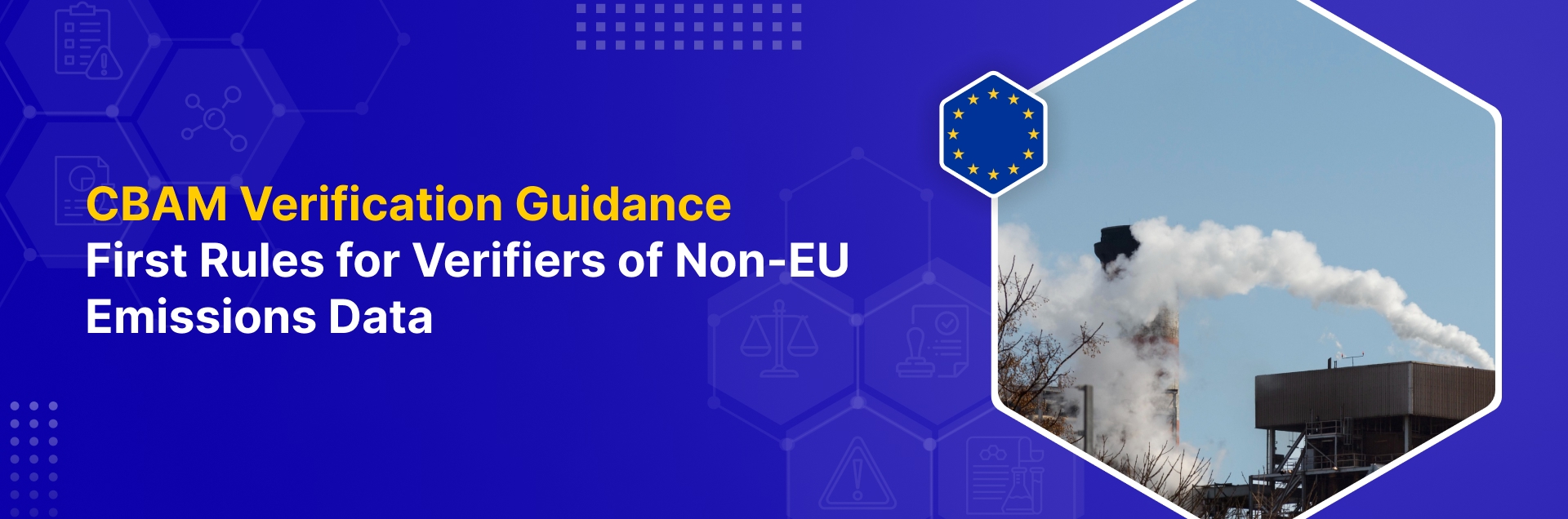
On 24 August 2026 the European Commission published its first guidance on CBAM verification and accreditation. It is aimed at third-party verifiers of non-EU installations and the national accreditation bodies that supervise them, and it sets out how verified emissions data will support CBAM declarations.
What the CBAM Verification Guidance Requires
The non-binding guidance explains how verifiers must assess emissions reports for installations producing CBAM goods in the definitive period, which began on 1 January 2026. It covers the six CBAM goods categories (cement, electricity, hydrogen, fertilisers, iron and steel, and aluminium) and applies EN ISO 17029, EN ISO 14065 and EN ISO/IEC 17011, with CBAM-specific rules on top.
Verification bodies must register in the CBAM registry within two months of obtaining CBAM accreditation, and are expected to begin issuing verification reports in January 2027, which lets importers use verified actual emissions in their declarations.
What’s New
- Reasonable assurance is required, with a quantitative materiality threshold of 5% of total specific embedded emissions per tonne of goods.
- Verifiers must assess the installation monitoring plan directly, a task not required under the EU ETS: a full assessment at first verification or after significant changes, simplified assessments in later years.
- Each report needs an independent quality review and must be submitted in English through the CBAM registry.
- Claims such as actual electricity emission factors require evidence, for example smart meter data, single-line diagrams and contracts.
- Site visits should generally be on site; virtual visits are allowed only under strict conditions, with exemptions capped at once every three years.
- Where precursor verification reports are relied upon, the issuing verifier must have held valid accreditation, the opinion must be positive and the data consistent.
Key Dates & Timeline
Who and What Is in Scope
Industries: Automotive components · Fasteners and metal formed parts · Metals and steel · Aluminium · Batteries · Electrical and electronic equipment
Who is affected: Third-party verifiers outside the EU, national accreditation bodies in Member States, non-EU installation operators asked for verified embedded-emissions data, and EU importers and authorised declarants relying on that data.
Products and standards in scope: CBAM goods in the six categories of the definitive period, including embedded emissions, precursors and the free-allocation adjustment.
Requirements and restrictions: No new prohibition. The guidance is explanatory; the CBAM Regulation and its implementing acts take precedence. The free-allocation adjustment factor declines from 97.5% in 2026 to 0% in 2034.
What Companies Should Do
- Ask non-EU steel and aluminium suppliers whether they have lined up an accredited verifier for 2026 data.
- Reconfirm that suppliers can provide actual verified emissions rather than default values.
- Prepare declarant evidence packs, including electricity emission-factor evidence where claimed.
Verified actual emissions will replace default values for CBAM declarations. Importers should confirm now that their non-EU suppliers have verification in place for the first reports in January 2027.
Related: CBAM compliance services | EU Parliament Position on CBAM Changes
European Commission — Carbon Border Adjustment Mechanism (Taxation and Customs Union) — https://taxation-customs.ec.europa.eu/carbon-border-adjustment-mechanism_en
Reach out to our regulation experts on chemical and product regulatory compliances