






























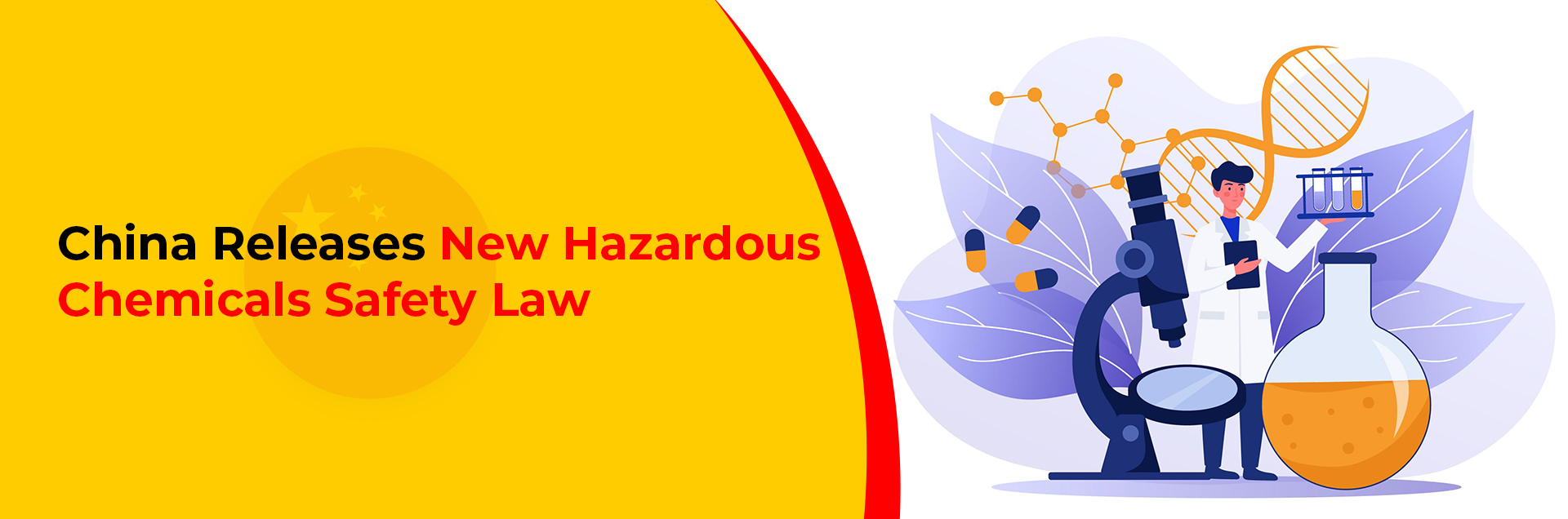
China has officially released the Hazardous Chemicals Safety Law of the People’s Republic of China, marking a significant upgrade to the country’s chemical safety regulatory framework. The law was adopted by the Standing Committee of the 14th National People’s Congress and will enter into force on 1 May 2026.
The new legislation establishes comprehensive and legally binding requirements for the management of hazardous chemicals across their entire lifecycle, aiming to reduce safety risks and strengthen regulatory oversight nationwide.
Purpose and Regulatory Scope
The Hazardous Chemicals Safety Law provides a unified legal basis for regulating hazardous chemicals from classification and production to storage, transportation, use, and emergency response. It replaces fragmented regulatory practices with a single, high-level law focused on prevention, accountability, and risk control.
Hazardous Chemicals Catalogue Management
The law introduces a dynamic hazardous chemicals catalogue system, led by the Ministry of Emergency Management in coordination with other authorities. Key elements include:
- Scientific identification and classification of hazardous chemicals
- Regular updates to the official hazardous chemicals catalogue
- Mandatory hazard identification and testing for substances with unclear risks
This approach ensures regulatory controls are aligned with actual hazard profiles.
Stricter Training and Personnel Qualification Requirements
Enterprises handling hazardous chemicals must strengthen personnel management by ensuring that:
- Employees receive systematic safety education and training
- Staff pass competency assessments before assuming duties
- Special operations are conducted only by certified and qualified personnel
These measures aim to reduce accidents caused by insufficient training or operational errors.
Mandatory Safety Assessments and Public Disclosure
The law requires hazardous chemical producers and storage operators to:
- Conduct safety assessment evaluations at least once every three years
- Engage qualified assessment institutions
- Identify safety risks and implement corrective measures
Assessment outcomes must be disclosed in accordance with regulatory requirements, enhancing transparency and accountability.
Safety Data Sheets and Chinese Labeling Requirements
To strengthen hazard communication, the law mandates that:
- Hazardous chemicals must be accompanied by Chinese-language Safety Data Sheets (SDS)
- Packaging must display compliant Chinese chemical safety labels
- Newly identified hazards must be promptly disclosed and reflected in updated SDS and labels
Downstream users are entitled to request SDS information from suppliers.
Registration Exemptions for Certain Uses
The law introduces registration exemptions for specific hazardous chemicals used in:
- Scientific research
- Experimental development
- Trial production or trial sales
These exemptions apply to low-exposure or low-release scenarios, subject to future implementing rules.
Clarified Transportation Requirements
The legislation clarifies the interface between hazardous chemicals management and dangerous goods transport rules. It confirms that:
- Hazardous chemicals must comply with this law and relevant transport regulations
- Properly treated hazardous chemicals may be transported as general cargo when risks are effectively controlled
This provides clearer guidance for logistics and supply chain operations.
Digital Supervision and Lifecycle Monitoring
Authorities are required to enhance information-based supervision, including:
- Electronic tracking of hazardous chemicals
- Lifecycle data management systems
- Improved risk monitoring across supply chains
These tools aim to strengthen early warning capabilities and enforcement efficiency.
Enhanced Oversight of Chemical Industrial Parks
Chemical industrial parks will be subject to stricter regulatory controls, including:
- Official designation and regular safety evaluations
- Monitoring of hazardous chemicals entering and leaving the park
- Ongoing risk assessments and emergency preparedness measures
Legal Liabilities and Penalties
The law establishes clear legal responsibilities and penalties for non-compliance, including violations related to:
- Safety assessments and personnel training
- SDS and labeling obligations
- Unauthorized production, storage, or handling of hazardous chemicals
These exemptions apply to low-exposure or low-release scenarios, subject to future implementing rules.
Industry Implications
The release of the Hazardous Chemicals Safety Law signals a shift toward more stringent, systematic chemical safety governance in China. Companies operating in or supplying to the Chinese market should:
- Review hazardous chemical classifications
- Strengthen internal safety and compliance systems
- Update SDS, labeling, and training programs
- Prepare for full compliance ahead of the May 2026 effective date
Reach out to our regulation experts on chemical and product regulatory compliances