
































The United States Environmental Protection Agency (EPA) has announced a delay to the reporting timeline under the Toxic Substances Control Act (TSCA) Section 8(a)(7) PFAS Reporting Rule.
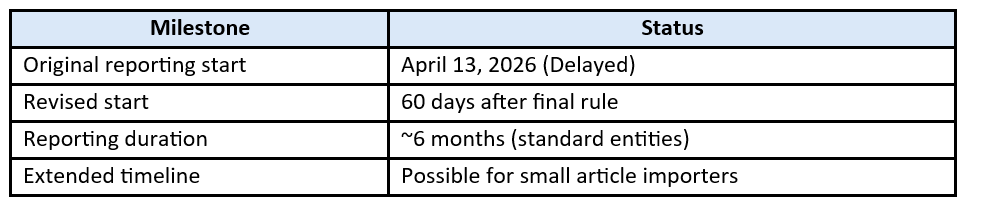
Originally scheduled to begin on April 13, 2026—the same day the rule became legally effective—the reporting period will now start on January 31, 2027, or 60 days after the effective date of a forthcoming final amended rule, whichever is earlier.
This revision provides companies additional time to prepare while indicating possible changes to reporting requirements and scope.
Regulatory Background
TSCA Section 8(a)(7) mandates one-time reporting of data on Per- and Polyfluoroalkyl Substances (PFAS) manufactured or imported into the United States between January 1, 2011, and December 31, 2022. The rule applies to substances, mixtures, and articles, requiring submission of all information known or reasonably ascertainable. It is regarded as one of the most comprehensive global PFAS data collection initiatives.
Key Changes
- Previous reporting start: April 13, 2026
- Revised approach: Begins 60 days after final amended rule
- Current status: No fixed start date until amendments are finalized
Reason for Delay
EPA cited several factors behind the postponement, including extensive public comments on proposed amendments (November 2025), the need to improve reporting clarity and data quality, technical upgrades to the Central Data Exchange (CDX) system, and alignment with anticipated rule revisions.
Scope and Applicability
The rule applies to entities that have manufactured PFAS domestically or imported PFAS, including within finished goods. This includes chemical manufacturers, mixture importers, and importers of finished articles.
Reporting Requirements
Companies must submit detailed data, including:
- Chemical identity (CAS RN, structure, trade name)
- Annual manufacturing and import volumes
- Use information (industrial, commercial, consumer)
- Exposure data (worker and environmental)
- Disposal and waste management practices
- Existing hazard and toxicological data
All submissions must be made through EPA’s CDX platform.
Proposed Amendments
EPA is evaluating revisions that may reduce reporting burden, such as a 0.1% concentration threshold, exemptions for certain imported articles, and exclusions for byproducts, impurities, intermediates, and R&D substances. These changes are not yet final.
Expected Timeline
|
Business Impact
The rule significantly affects global supply chains, especially in automotive, electronics, and industrial manufacturing sectors. Key challenges include limited supplier data visibility, difficulty retrieving historical data, and complexity in PFAS identification.
Recommended Actions
Organizations are advised to begin PFAS inventory assessments, engage suppliers for disclosures, identify data gaps, align internal systems with TSCA requirements, and monitor EPA updates on the final rule.
Key Takeaway
While the delay offers temporary relief, it reinforces the complexity of PFAS reporting. Companies should use this extended timeline to strengthen compliance readiness ahead of final regulatory requirements.
Source:TSCA Section 8(a)(7)_Extended Deadline | US federal Register
Reach out to our regulation experts on chemical and product regulatory compliances