




















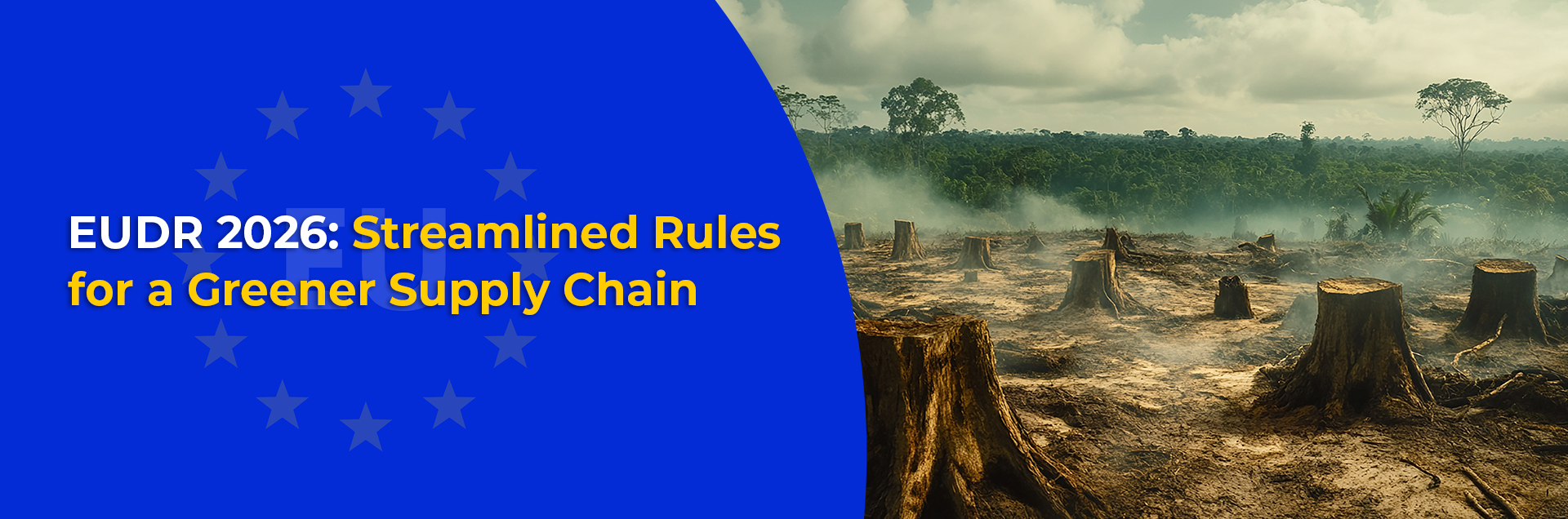
EUDR 2026 Update: Simplified Rules, New Deadlines in the EU
In May 2026, the European Commission introduced a major implementation support package for the EU Deforestation Regulation (EUDR). The update is designed to simplify compliance, improve regulatory clarity, and address practical challenges raised by businesses.
Importantly, the core regulation remains unchanged. Instead, the focus is on strengthening implementation through updated guidance, system enhancements, and targeted scope clarifications.
Report to Parliament and Council
As part of the update, the Commission released a report to the European Parliament and Council outlining the current state of EUDR implementation and the challenges faced by businesses and authorities.
Key highlights include:
- Reducing administrative burden across supply chains
- Ensuring harmonized enforcement across EU Member States
- Progress in developing digital compliance systems
- Industry feedback on complexity and data requirements
This report forms the basis for the 2026 simplification measures.
Updated FAQs and Guidance
The Commission has issued revised FAQs and guidance documents to clarify regulatory expectations and improve consistency in compliance.
These updates cover:
- Detailed due diligence obligations
- Roles of operators, traders, and downstream actors
- Geolocation and traceability requirements
- Definitions such as “deforestation-free”
These documents are essential for companies aligning their compliance frameworks.
Draft Delegated Act: Product Scope Changes
A key component of the update is the Draft Delegated Act introducing targeted amendments to product scope.
Proposed Additions
- Soluble coffee and processed coffee derivatives
- Specific palm oil derivatives used in industrial and consumer goods
These additions aim to capture products indirectly linked to deforestation risks.
Proposed Exclusions
- Leather products
- Retreaded tyres
These are excluded where deforestation linkage is minimal or difficult to trace.>
Proposed Exemptions
- Product samples
- Packaging materials
- Second-hand goods
- Waste materials
These exemptions ensure proportional and practical application of the regulation.
Public Consultation
The Draft Delegated Act is open for public consultation for approximately four weeks from May 2026, closing around June 2026.
Stakeholders can provide feedback on:
- Scope additions
- Exclusions and exemptions
- Implementation challenges
This phase allows refinement before final adoption.
Staff Working Document
An accompanying Staff Working Document provides deeper insights into:
- Relevant commodities such as wood, soy, and palm oil
- Methodologies for assessing deforestation risk
- Justification for scope inclusion or exclusion
This is a key resource for compliance and risk assessment teams.
EUDR Information System Update
A major operational enhancement is the update to the EUDR Information System, including a new voluntary “grouping feature.”
Benefits include:
- Grouping multiple shipments under one Due Diligence Statement (DDS)
- Reduced duplicate data submissions
- Simplified reporting for high-volume operators
This strengthens the system as the central compliance hub.
Simplified Due Diligence
The updated framework reduces redundancy across supply chains:
- Primary operators submit the DDS
- Downstream actors retain and reference DDS data
- Duplicate due diligence requirements are minimized
This improves efficiency, especially in complex global supply chains.
No Dilution of Policy Goals
The European Commission has confirmed:
- No rollback of EUDR requirements
- No change to deforestation-free obligations
- Continued emphasis on traceability and risk assessment
The update focuses on simplification without weakening environmental standards.
What This Means for Businesses
Companies should now prioritize implementation over interpretation.
Recommended actions:
- Review updated FAQs and guidance
- Assess product scope using new documents
- Adapt to system enhancements
- Align internal processes with simplified due diligence
Key Takeaway
The 2026 EUDR update marks a shift toward practical, business-friendly compliance while maintaining strict environmental safeguards. Businesses must adapt quickly to ensure alignment with the updated framework.
Source: EU Commission EUDR Update
Reach out to our regulation experts on chemical and product regulatory compliances