

































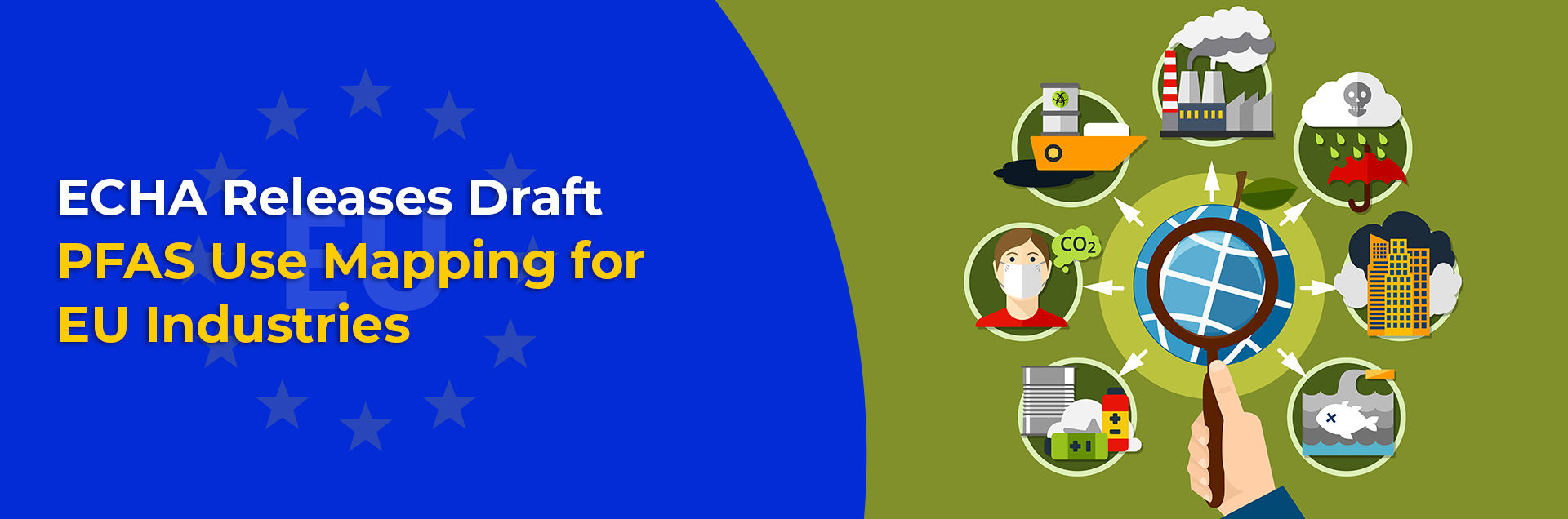
The European Chemicals Agency (ECHA) has released a draft PFAS use-mapping document, offering the most detailed overview yet of where and how PFAS are used across EU industrial, professional, and consumer sectors. This mapping forms the foundation for public consultation and future decisions on a broad EU-wide PFAS restriction under REACH.
What the Mapping Includes
The draft organizes PFAS uses through a structured hierarchy:
Sector → Use Category → Sub-use → Application
Major sectors identified include:
• Consumer mixtures (e.g., cleaners, waxes, polishes)
• Cosmetics (containing PFAS)
• Metal plating and manufacturing
• Oil and mining (e.g., tracers, defoamers)
• Textiles, apparel, leather, carpets (TULAC)
• Food contact materials and packaging
• Construction products (e.g., coatings, sealants)
• Fluorinated gas applications (e.g., refrigeration, air conditioning, firefighting)
• Medical devices (implantable and non-implantable)
• Transport (aviation, automotive, marine)
• Energy (solar, wind, hydrogen, batteries)
• Electrical equipment (e.g., insulating gases, switchgear)
• Lubricants (industrial, professional, consumer)
• Electronics and semiconductors (TBD)
• PFAS manufacturing (TBD)
ECHA’s committees — RAC (Risk Assessment Committee) and SEAC (Socio-Economic Analysis Committee) — will use this mapping for their evaluations. SEAC has already preliminarily agreed to examine 13 priority use areas.
Significance: PFAS Under Tightening Regulations
PFAS (Per- and Polyfluoroalkyl Substances) are valued for resistance to heat, water, stains, chemicals, and corrosion.
However, many are:
• Highly persistent
• Bioaccumulative
• Environmentally mobile
• Linked to health harms such as cancer, endocrine disruption, and reproductive impacts
The EU already restricts several PFAS, and the new mapping strengthens the case for a sweeping, universal restriction now under review.
Responsibilities
This development is especially important for:
• Automotive, electronics, plastics, textiles, coatings, chemicals, and battery manufacturers
• Importers/exporters dealing with EU products or materials
• Compliance, regulatory, ESG, sustainability, and chemical-safety teams
• Product design, procurement, and engineering divisions planning material substitutions
PFAS restrictions could significantly affect components, materials, formulations, surface treatments, and supply-chain declarations.
Recommended Actions for Stakeholders
1. Review PFAS Presence in Materials & Components
Check fluoropolymers, coatings, surfactants, additives, sealants, membranes, and chemical mixtures.
2. Map the Supply Chain
Trace PFAS inputs from suppliers, sub-suppliers, and contract manufacturers.
3. Monitor Regulatory Timelines
Watch ECHA’s consultation updates and SEAC’s draft opinion (expected 2026).
4. Evaluate PFAS Alternatives
Assess non-PFAS materials, coatings, adhesives, and production processes.
5. Strengthen Compliance & Disclosure Systems
Update internal substance inventories and ensure accurate supplier declarations for REACH-related obligations.
Reference: ECHA PFAS Draft
Reach out to our regulation experts on chemical and product regulatory compliances