
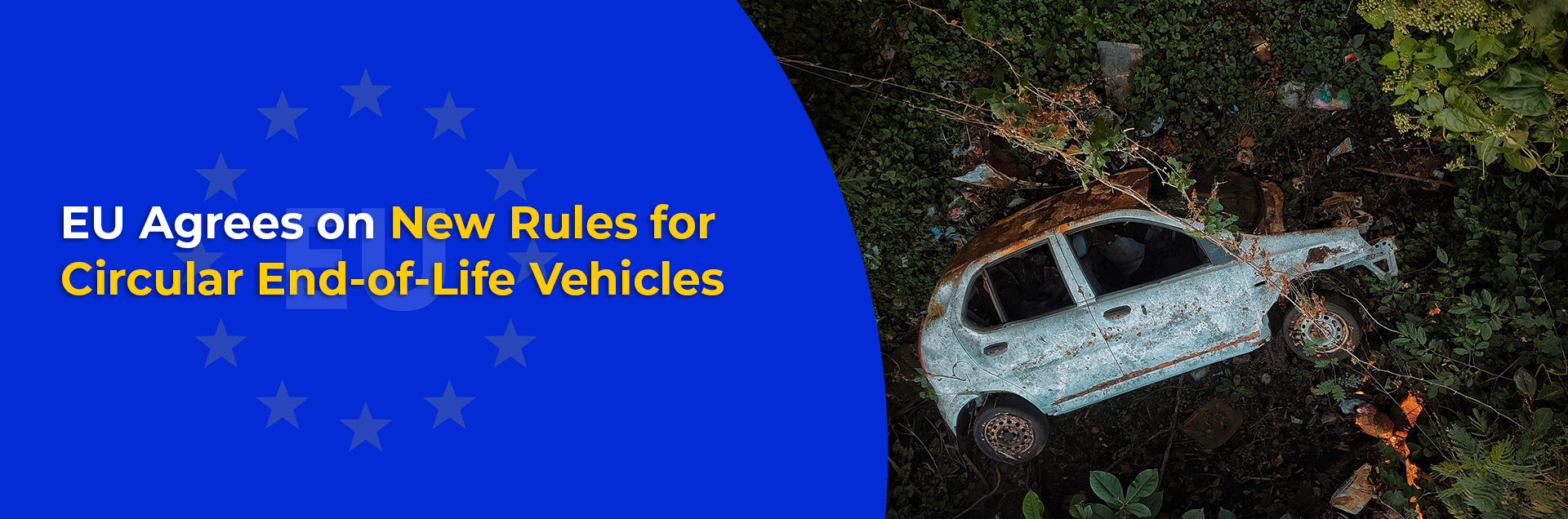
Each year in the EU, 3–4 million vehicles disappear from official records after deregistration. Authorities often do not know whether these vehicles are:
- Properly recycled
- Exported
- Illegally scrapped
This leads to material losses, environmental harm, and missed recycling opportunities.
Following a review of existing legislation, the European Commission proposed a new ELV Regulation in July 2023 to address these issues.
Overview
The European Commission has welcomed a provisional agreement between the European Parliament and the Council on a new End-of-Life Vehicles (ELV) Regulation.
The Regulation introduces clear rules covering the design, production, use, and end-of-life treatment of vehicles, with the goal of making the EU automotive sector more circular, sustainable, and resource-efficient.
Importance
The automotive industry is one of the EU’s largest users of raw materials, including steel, aluminium, copper, and plastics.
When vehicles are not properly collected and recycled at the end of their life, valuable materials are lost, exported, or disposed of in environmentally harmful ways.
The new ELV Regulation aims to:
- Reduce waste and pollution
- Increase recycling and reuse of materials
- Lower dependence on imported raw materials
- Strengthen the EU’s supply-chain resilience
Under the new rules, the EU could recover:
- Hundreds of tonnes of rare earth materials
- 5–6 million tonnes of steel
- 1–2 million tonnes of aluminium
- 0.2–0.3 million tonnes of copper
This supports a competitive, resilient, and sustainable European automotive industry.
Important Measures in the ELV Regulation
1. Improved Vehicle Design
Vehicles must be designed to be easier to dismantle and recycle. Manufacturers will be required to provide clear instructions for removing and replacing parts during vehicle use and at end-of-life.
2. Mandatory Use of Recycled Plastics
From 2036, vehicles must contain at least 25% recycled plastics, with:
- 20% sourced directly from end-of-life vehicles
These requirements apply to both EU-produced and imported vehicles.
The EU may also introduce future recycled-content targets for other materials.
3. Better End-of-Life Treatment
The Regulation sets higher treatment standards to improve material recovery.
At least 30% of plastics from ELVs must be recycled, increasing material quality and reuse.
4. More Reuse and Repair
The new rules promote:
- Reuse of parts
- Remanufacturing and refurbishment
- Greater availability of second-hand spare parts
This will help reduce repair costs for consumers and extend vehicle life.
5. Stronger Producer Responsibility
Vehicle manufacturers will have increased responsibility for vehicles at end-of-life through harmonised Extended Producer Responsibility (EPR) schemes across the EU.
These schemes will:
- Fund proper ELV collection and treatment
- Encourage higher-quality recycling outcomes
6. Stronger Enforcement and Export Controls
The Regulation introduces:
- Increased inspections
- Clear rules distinguishing used vehicles from ELVs
Only road-worthy vehicles may be exported outside the EU, ensuring that end-of-life vehicles are treated in an environmentally sound manner.
Further Steps
Once formally adopted by the European Parliament and the Council, the Regulation will enter into force 20 days after publication in the EU Official Journal.
Alignment with EU Policies
The ELV Regulation supports key EU initiatives, including:
- Critical Raw Materials Act
- Industrial Action Plan for the Automotive Sector
- European Steel and Metals Action Plan
- RESourceEU Communication
- Upcoming Circular Economy Act
Vehicles Covered
A vehicle is considered end-of-life when it is beyond repair. The basic principle is that a vehicle shall be considered an ELV when it is irreparable. Historic vehicles are excluded from the scope of this Regulation.
-
What Is a Historic Vehicle?
A historic vehicle is usually 30 years or older, kept for heritage or collection, not used daily, and often has special classic registration. These vehicles are maintained by collectors or museums.
-
Why Historic Vehicles Are Excluded
Historic vehicles are rare and preserved, not waste. They are restored or displayed, not scrapped, making ELV recycling rules unnecessary and impractical.
In future, it Cover more vehicles. Gradually it extends the scope of the rules to all lorries, buses and motorcycles.
Conclusion
The new End-of-Life Vehicles Regulation marks a major step toward a circular automotive economy in the EU.
It will help:
- Reduce waste
- Recover valuable materials
- Protect the environment
- Strengthen Europe’s industrial resilience
Source: EU Circular ELV Agreement
Reach out to our regulation experts on chemical and product regulatory compliances