
1. Project Background
A European chemical facility operating a multi-consumer liquid distribution system was experiencing unstable flow conditions and recurring pump reliability concerns during peak demand scenarios.
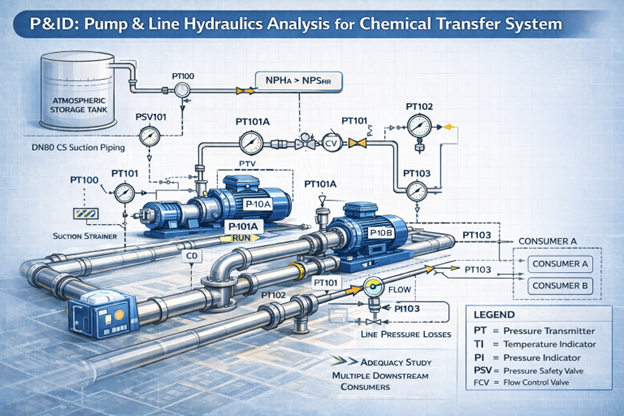
The system transferred a medium-density chemical (~840–1400 kg/m³) from atmospheric storage tanks to multiple downstream units via a branched DN80 pipeline network.
The client’s key concern:
“Can the existing system reliably supply all consumers without risking cavitation or low-pressure failures?”
Failure to resolve this could result in:
- ● Pump damage due to cavitation
- ● Production interruptions across multiple units
- ● Potential redesign or pump replacement costs
A detailed pump and line hydraulics study was initiated to validate system performance and define safe operating limits.
2. Scope of Work
The project focused on performing process engineering analysis for the transfer system, including review of PFDs and P&IDs, verification of pump suction and discharge hydraulics, and assessment of NPSH availability. Detailed line pressure loss calculations covering pipes, fittings, and valves were carried out, along with evaluation of multiple operating scenarios (single and simultaneous consumers). The study also defined key assumptions, calculation basis, and conclusions, culminating in the preparation of a comprehensive calculation note aligned with client review and approval requirements.
3. Applicable Codes, Standards, and Guidelines
The hydraulic analysis was performed in compliance with the following standards and guidelines:
- ● ISO 5199 / ISO 2858 – Technical requirements for centrifugal pumps
- ● API 610 – Centrifugal pumps for petroleum, petrochemical, and gas industry services
- ● ISO 13709 – Centrifugal pumps for chemical and petrochemical industries
- ● API 14E – Diagrams for the chemical and petrochemical industry (PFDs & P&IDs)
- ● GPSA –Technical standards, engineering data and best practices for NG processing and gas plant design.
- ● API 14E – Process piping and Piping Systems
- ● Client – specific engineering standards and pipe classes
4. Engineering Challenges
Unlike typical hydraulic checks, this project had a critical system-level constraint:
The network had to support multiple consumers simultaneously, each with varying and intermittent demand.
During the initial review, the following challenges were identified:
- ● Potential risk of insufficient Net Positive Suction Head (NPSH) at the pump inlet
- ● Increased friction losses due to long pipe runs and fittings.
- ● Variability in operating flow rates compared to design conditions.
- ● Risk of inadequate pressure at downstream consumers during peak demand
5. Hydraulic Analysis Methodology
The study involved detailed NPSH verification on the pump suction side in accordance with API 610 and GPSA standards, including evaluation of suction-side friction losses using the Darcy–Weisbach equation and minor losses through resistance coefficients, while accounting for vessel pressure, elevation head, and vapor pressure. The NPSH Available (NPSHa) was compared against the NPSH Required (NPSHr) from the pump datasheet, confirming a margin of approximately 1.5–2 m across all operating cases and ensuring stable, cavitation-free operation.
In addition, comprehensive line pressure loss calculations were carried out as per ASME B31.3, incorporating pipe roughness, losses from valves, reducers, expansions, and bends, and evaluating multiple operating and load scenarios. Pressure profiles were developed for each consumer branch, and the analysis concluded that simultaneous supply to all consumers is not feasible under certain conditions, as downstream pressures fall below minimum acceptable limits.
6. Conclusion
The study delivered a comprehensive and standards-compliant hydraulic assessment of the transfer system, confirming that pump suction hydraulics are adequate with an NPSH margin exceeding 1.5 m, ensuring reliable and cavitation-free operation. The analysis identified line pressure losses as the governing factor for system performance, with pressure drops reaching up to 20–30% below acceptable limits in worst-case scenarios, thereby defining clear operational constraints. Stable operation was achieved by optimizing and limiting simultaneous consumer combinations.
The outcome provided a fully validated engineering basis aligned with international standards, enhancing system reliability and operational understanding. It enabled clear identification of hydraulic limitations to support informed design and operational decisions, while significantly reducing risks associated with cavitation and low-pressure conditions. Overall, the study demonstrated the critical importance of structured pump and line hydraulics analysis in ensuring safe, efficient, and reliable plant operation, supported by a professionally documented deliverable ready for client review and implementation.
👉 Talk to Our Technical Experts