

































Overview
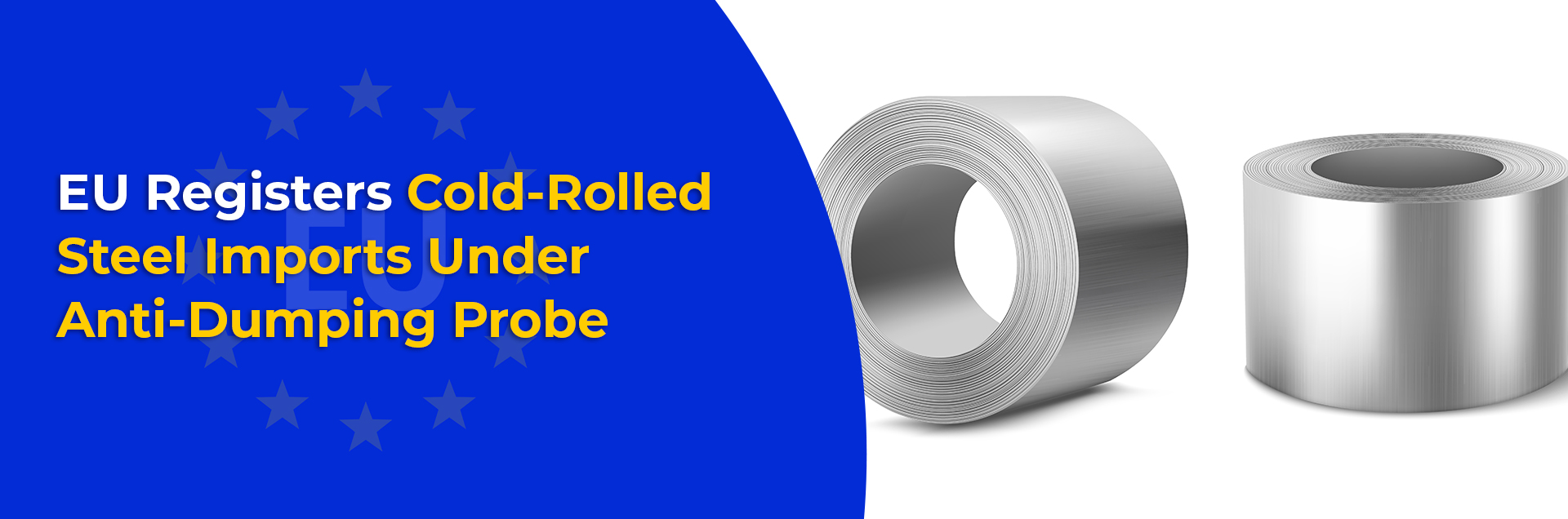
The European Commission has adopted Commission Implementing Regulation (EU) 2025/2432, introducing a mandatory customs registration requirement for imports of certain cold-rolled flat steel products from selected non-EU countries.
The measure forms part of an ongoing anti-dumping investigation and allows the European Union to impose retroactive anti-dumping duties if definitive measures are adopted at a later stage.
Regulatory Context
The regulation is adopted under Article 14(5) of Regulation (EU) 2016/1036, the EU’s Basic Anti-Dumping Regulation.
Following a substantiated complaint from the European steel industry, the Commission initiated an investigation after finding prima facie evidence that:
- The concerned products were allegedly dumped on the EU market, and
- Such imports caused, or threatened to cause, material injury to EU producers.
To ensure the effectiveness of any future trade-defense measures, the Commission has decided to register imports during the investigation period.
Products Covered
The regulation applies to cold-rolled flat products of iron or non-alloy steel and other alloy steel that:
- Are cold-rolled (cold-reduced),
- Are not clad, plated, or coated, and
- I have not undergone further processing beyond cold rolling.
The scope is clearly defined through:
- Specific thickness and width thresholds,
- Explicit product exclusions, and
- Designated CN and TARIC codes, ensuring uniform enforcement across all EU Member States.
Countries Concerned
The registration requirement applies to imports originating from:
- India
- Japan
- Taiwan
- Türkiye
- Vietnam
These countries are subject to investigation due to alleged dumping practices affecting the EU steel sector.
Customs Registration Requirement
EU customs authorities must register all imports of the covered products from the listed countries.
Key implications include:
- Registration allows the EU to impose retroactive anti-dumping duties from the date of registration to begin, if definitive duties are later adopted.
- The registration period may apply for up to nine months, unless modified or repealed earlier.
Impact on Importers
Importers should be aware that:
- Goods imported during the registration period may face retroactive duty liabilities,
- Future definitive duties could affect pricing and contractual arrangements, and
- Customs declarations and supply chain strategies may require reassessment.
Businesses importing steel products into the EU are advised to closely monitor the investigation progress and assess potential financial exposure.
Data Protection
Any personal or commercial data collected during the registration process will be processed in accordance with Regulation (EU) 2018/1725, ensuring compliance with EU data protection requirements for EU institutions.
Key Dates
| Milestone | Date |
|---|---|
| Anti-dumping complaint submitted | August 2025 |
| Investigation initiated | September 2025 |
| Regulation adopted | 3 December 2025 |
| Published in Official Journal | 4 December 2025 |
| Registration validity | Up to 9 months |
Next Steps
- The anti-dumping investigation will continue, including verification of submissions from exporters, importers, and EU producers.
- Provisional measures may be proposed at a later stage.
- A final decision on definitive anti-dumping duties will be taken upon the conclusion of the investigation.
Takeaway
Regulation (EU) 2025/2432 is a precautionary trade-defence measure that strengthens the EU’s ability to protect its steel industry while preserving the option to impose effective remedies if dumping is confirmed.
Source: EU Steel Imports Update
Reach out to our regulation experts on chemical and product regulatory compliances