



























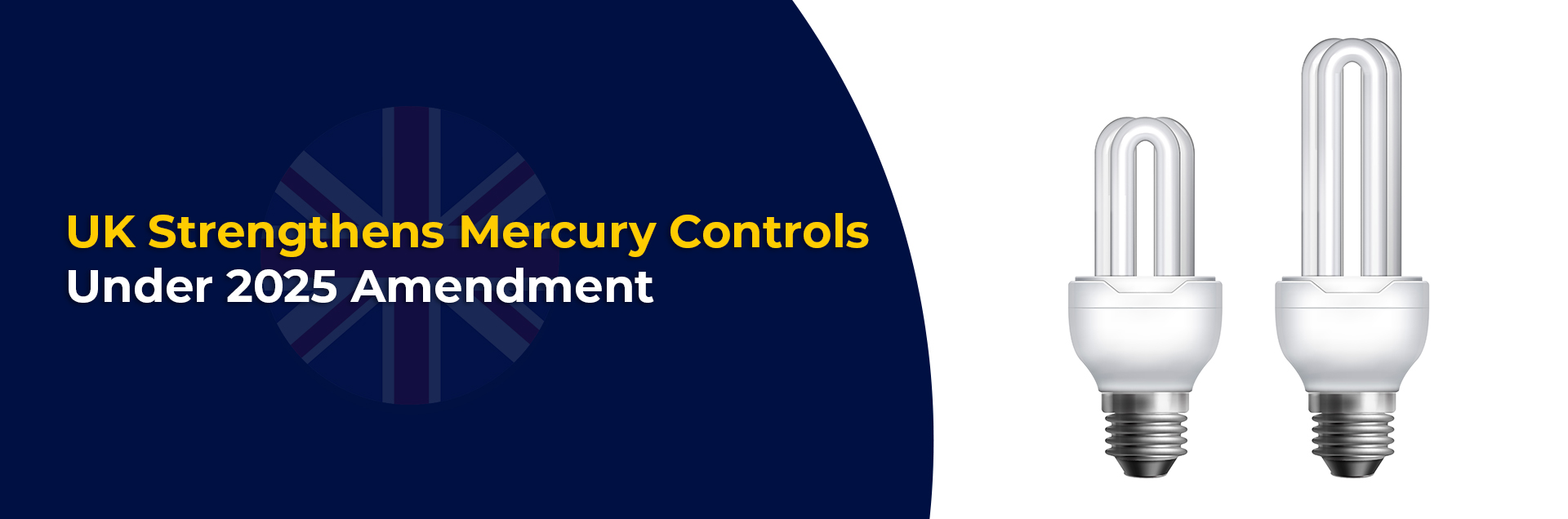
The UK Government has introduced the Control of Mercury (Amendment) Regulations 2025, formalised under Statutory Instrument SI 2025/1255, strengthening national controls on mercury-added products.
Published: 2 December 2025
In Force: 23 December 2025
Legislative Procedure: Negative resolution (subject to Parliamentary annulment)
Overview of the Regulation
The 2025 amendment updates the existing Mercury Regulations by expanding the list of mercury-added products (MAPs) that will be progressively phased out across Great Britain. The measure reinforces environmental safeguards and brings UK legislation into closer alignment with the Minamata Convention on Mercury, a global treaty designed to reduce mercury’s risks to human health and the environment.
Why This Update Is Important
Mercury is a highly toxic substance with long-term environmental and public health consequences. By tightening regulatory controls, the UK aims to:
- Prevent the import, export, and manufacture of additional mercury-containing products
- Fulfil international obligations under the Minamata Convention
- Formalise industry-led phase-outs and address remaining regulatory gaps
Products Affected by the Phase-Out
The amended regulation adds several product categories to the existing prohibition list, including:
- Fluorescent lamps, including compact (CFL), linear (LFL), and non-linear types
- Electrical and electronic measuring devices, such as melt pressure sensors and transducers
- Mercury vacuum pumps
- Photographic film and paper
- Tyre balancers and wheel weights
- Propellants used in satellites and spacecraft
Products already placed on the Great Britain market may continue to be used or sold until the end of their service life or until stocks are exhausted.
Phased Implementation Timeline
To allow businesses and supply chains sufficient transition time, the restrictions will be introduced in stages:
- 31 December 2025 – Initial phase-outs
- 31 December 2026 – Intermediate phase-outs
- 31 December 2027 – Completion of final phase-out obligations
This staged approach supports a gradual shift toward mercury-free alternatives where feasible.
Policy Context and Regulatory Alignment
International Commitments
The amendment implements outcomes from the 4th and 5th Conferences of the Parties (COPs) to the Minamata Convention, reflecting strengthened global action on mercury reduction.
Domestic and Regional Alignment
The UK framework broadly mirrors environmental controls in the EU and Northern Ireland, supporting regulatory consistency under the Windsor Framework.
Practical Impact
According to Defra, the affected products:
- Have limited ongoing use in Great Britain
- Are largely already phased out by industry
- Have viable alternatives available across affected sectors
Conclusion
The Control of Mercury (Amendment) Regulations 2025 mark a further step in the UK’s commitment to reducing hazardous substances. By expanding mercury product restrictions and aligning with international standards, the regulation enhances environmental protection while providing industry with a clear and manageable transition pathway.
Reach out to our regulation experts on chemical and product regulatory compliances