

































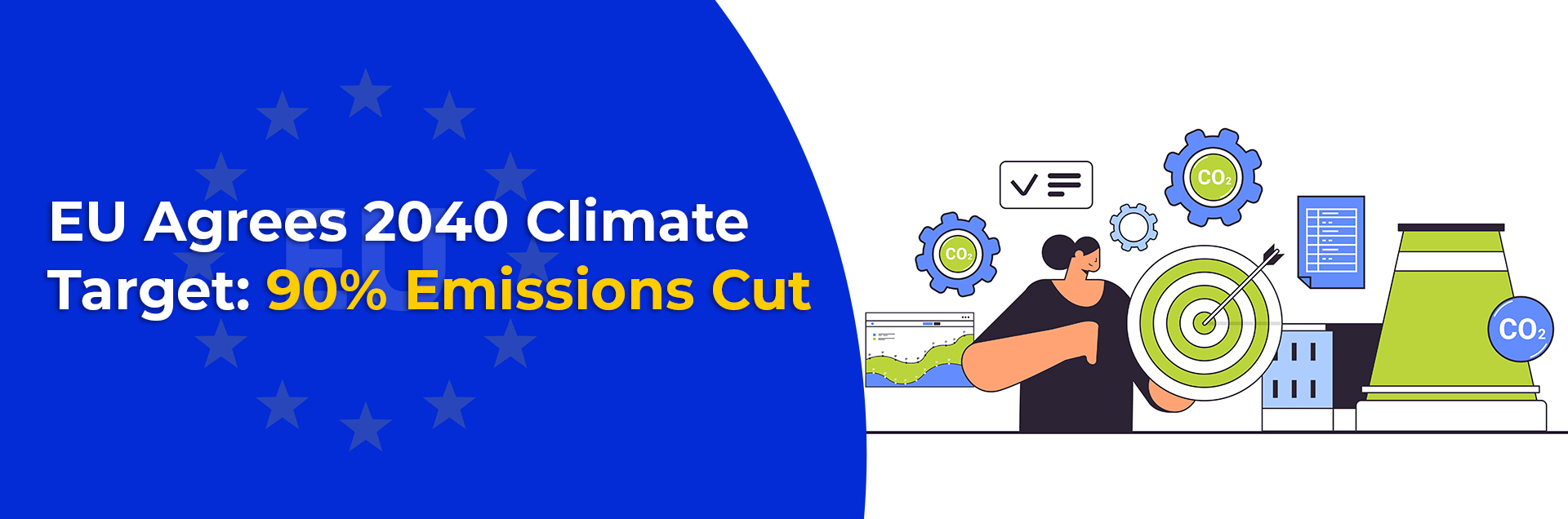
The European Parliament, the Council of the EU, and the European Commission have reached a provisional political agreement to amend the European Climate Law, introducing a legally binding 2040 climate target. Under the agreement, the European Union will reduce net greenhouse gas (GHG) emissions by 90% by 2040, compared with 1990 levels.
This new milestone bridges the gap between the EU’s 2030 target (55% reduction) and its long-term objective of achieving climate neutrality by 2050, strengthening policy certainty for governments, industries, and investors.
2040 Target
Core Commitment
The EU formally commits to a 90% net reduction in GHG emissions by 2040, reinforcing the legally binding pathway toward climate neutrality as enshrined in the European Climate Law.
Why it matters?
- Closes the policy gap between 2030 and 2050 climate goals
- Provides long-term certainty for investment, innovation, and industrial planning
- Aligns EU climate action with latest climate science
- Strengthens EU credibility ahead of international climate negotiations such as COP30
Components of the Agreement
Flexibility Mechanisms
To balance climate ambition with economic competitiveness, the agreement introduces targeted flexibility options.
a. International Carbon Credits
- From 2036, Member States may use high-quality international carbon credits to cover up to 5 percentage points of the required emissions reductions.
- Credits must be fully aligned with the Paris Agreement.
- Safeguards are included to prevent financing projects that conflict with EU environmental or strategic interests.
b. Domestic Carbon Removals
- The agreement allows permanent domestic carbon removals, such as:
- Afforestation and land-based removals
- Technological solutions like carbon capture
- These removals may help offset hard-to-abate emissions, particularly under the EU Emissions Trading System (EU ETS).
Implementation Tools and Timeline Adjustments
a. ETS2 Postponement
- The launch of EU ETS2, covering emissions from buildings and road transport fuels, is postponed by one year.
- New start date: 2028 (instead of 2027)
- The delay allows Member States additional time for technical and administrative preparedness.
b. Biennial Progress Reviews
The European Commission will conduct progress reviews every two years, assessing:
- Scientific and technological developments
- Industrial competitiveness
- Energy prices and economic impacts
- Progress on carbon removals
Based on these reviews, the Commission may propose adjustments or legislative reinforcements to ensure the 2040 target remains achievable.
Political Process: What Comes Next
- The European Parliament must formally approve the agreement.
- The Council of the EU must adopt it.
- Once published in the EU Official Journal, the amended Climate Law will enter into force 20 days later.
EU Climate Targets
| Target Year | Objective | Legal Status |
|---|---|---|
| 2030 | −55% net GHG emissions vs 1990 | Legally binding |
| 2040 | −90% net GHG emissions vs 1990 | Newly agreed |
| 2050 | Climate neutrality | Long-term EU law goal |
These targets form the backbone of the European Green Deal, supporting sustainable growth, cleaner industry, and enhanced energy security.
Stakeholder Perspectives
a. European Parliament
-
- Pushed for greater flexibility through international credits
- Emphasized strong safeguards and expanded use of domestic carbon removal
b. Council of the EU
- Supported the binding 90% target
- Backed flexibility mechanisms to ensure fairness and competitiveness across Member States
c. European Commission
- Laid the groundwork for the target
- Highlighted the importance of predictability for investors, innovation, and Europe’s long-term energy transition
Implications and Debate
a. Environmental Impact
The 90% reduction target places the EU among the most ambitious climate leaders globally, reinforcing efforts to limit global temperature rise.
b. Concerns and Criticism
- Some stakeholders caution that international carbon credits could dilute domestic decarbonization if safeguards are weak.
- Certain Member States previously raised concerns around cost, feasibility, and competitiveness, though compromises were reached during negotiations.
Reach out to our regulation experts on chemical and product regulatory compliances