

















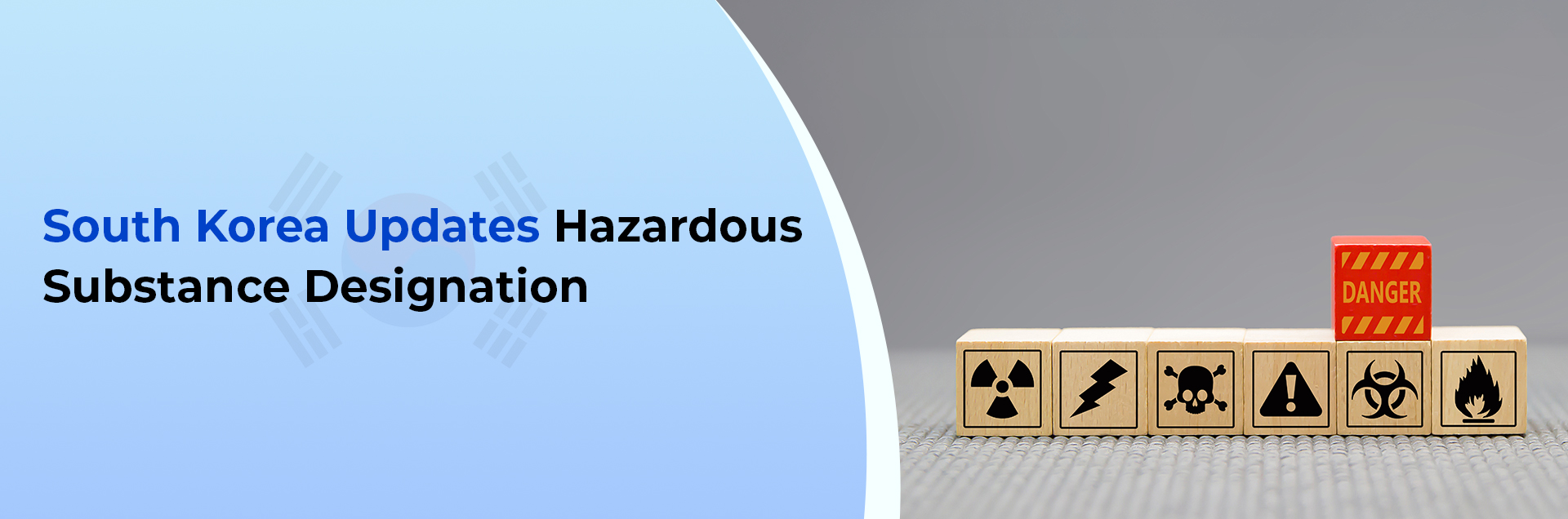
South Korea has proposed updates to its hazardous substance designation framework, refining skin corrosion classification criteria and expanding the regulated list of chemicals.
On 2 December 2025, the National Institute of Chemical Safety (NICS) issued Announcement No. 128 of 2025 under the Chemical Substances Registration and Evaluation Act (K-REACH). The draft amendment revises the Designation Notice of Human Acute Hazardous Substances, Human Chronic Hazardous Substances, and Ecological Hazardous Substances and is open for public consultation.
Purpose and Regulatory Background
The proposed revision reflects recent amendments to Korea’s chemical safety regulations and aims to improve the scientific accuracy and consistency of hazardous substance management. By updating classification criteria and reassessing regulated substances, the authorities seek to strengthen protection of human health and the environment while improving regulatory clarity for industry.
Refined Skin Corrosion Classification Criteria
A major change in the draft notice is the refinement of skin corrosion hazard classification. Previously, designation was largely limited to Skin Corrosion Category 1A. Under the proposed revision, the designation scope is expanded to include the full Category 1 range, covering:
- Category 1A
- Category 1B
- Category 1C
This update aligns hazardous substance designation more closely with current toxicological assessment standards.
Addition of 75 Newly Designated Hazardous Substances
Based on completed hazard evaluations, the draft proposes adding 75 substances to the list of Human, etc. Hazardous Substances. These substances are assigned unique identification numbers from 2025-1-1281 to 2025-1-1355 and meet the updated criteria for human acute toxicity, chronic toxicity, or ecological hazards.
The newly proposed substances are distributed across skin corrosion sub-categories:
- Skin Corrosion Category 1A: Unique Nos. 2025-1-1335 and 2025-1-1336
- Skin Corrosion Category 1B: Includes Unique Nos. 2025-1-1281 to 1288, 1290 to 1305, 1307 to 1319, 1321, 1322, 1326, 1327, 1329 to 1334, 1338 to 1352, 1354, and 1355
- Skin Corrosion Category 1C: Unique Nos. 2025-1-1289, 1292, 1306, 1314, 1320, 1323 to 1325, 1328, 1337, and 1353
Among these, sodium hypochlorite (Unique No. 2025-1-1355) is also classified as an ecological hazardous substance.
Updates to Existing Hazardous Substance Entries
The draft amendment also proposes updates to existing listings to improve clarity and traceability. Korean names and CAS numbers are added or corrected for substances with unique identification numbers 97-1-119, 97-1-379, and 97-1-417.
Proposed Compliance Grace Periods
To support industry transition, the draft sets out phased grace periods under the Chemical Substances Control Act (CSCA), including:
- Chemical status confirmation (Article 9): by 1 January 2027
- Hazard labelling requirements (Article 16): by 1 January 2027
- Import notification obligations (Article 20): by 1 January 2027
- Chemical accident prevention plans (Article 23): by 1 July 2028
- Business permits and notifications (Article 28): by 1 July 2028
- Handling standards compliance (Article 13): by 1 July 2027
- Facility standard compliance (Article 24): by 1 July 2030
For sodium hypochlorite (Unique No. 2025-1-1355), certain deadlines are extended by one additional year due to its ecological hazard classification.
Public Consultation Timeline
NICS is inviting comments from stakeholders, including manufacturers, importers, and industry associations.
- Public comment deadline: 22 December 2025
- Submission method: As specified in the official NICS announcement
Feedback received during the consultation period will be considered before the revision is finalised.
Implications for Industry
Companies operating under K-REACH should:
- Review whether any of the 75 newly proposed substances are present in their portfolios
- Assess potential impacts on classification, labelling, notification, and permitting obligations
- Consider submitting comments during the consultation period
- Prepare for compliance within the proposed transition timelines once the amendment is finalised
The final version of the revised designation notice will determine enforceable obligations under South Korea’s chemical regulatory framework.
Source: Korea Expands Hazard List
Reach out to our regulation experts on chemical and product regulatory compliances