






























ECHA Proposes New Occupational Exposure Limits for Lithium Compounds
The European Chemicals Agency (ECHA) has published a scientific assessment proposing occupational exposure limits (OELs) for three widely used lithium compounds and opened a two-month public consultation on the recommendations.
The assessment focuses on lithium carbonate, lithium chloride, and lithium hydroxide, all of which are classified for reproductive toxicity under EU chemical safety frameworks.
The consultation began on April 1, 2026, and will remain open until June 1, 2026.
Lithium Compounds Covered by the Assessment
The scientific review applies to the following substances:
- Lithium carbonate (CAS No. 554-13-2)
- Lithium chloride (CAS No. 7447-41-8)
- Lithium hydroxide (CAS No. 1310-65-2)
These compounds are widely used across:
- Battery manufacturing
- Energy storage systems
- Chemical processing
- Ceramics and glass production
- Industrial materials sectors
The assessment reflects growing regulatory attention on occupational exposure risks linked to lithium-related industrial expansion, particularly in the battery supply chain.
Proposed Occupational Exposure Limits
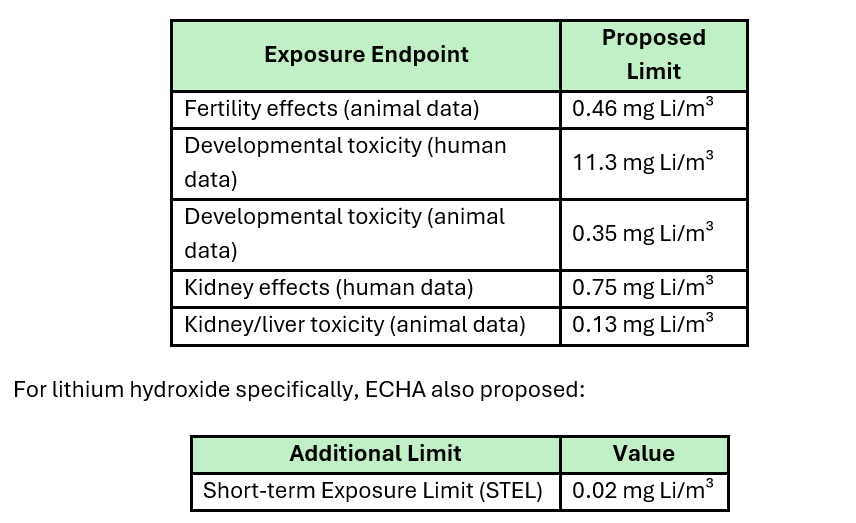
ECHA’s report evaluates multiple toxicological endpoints and proposes several 8-hour time-weighted average (TWA) exposure values.
|
The STEL recommendation is based on the corrosive properties of lithium hydroxide.
Key Scientific Recommendations
ECHA’s assessment recommends that the Risk Assessment Committee (RAC) consider several issues before finalizing occupational exposure limits.
Key recommendations include:
- Evaluating whether final OELs should rely primarily on human developmental toxicity data or more conservative animal toxicity findings
- Introducing a short-term exposure limit specifically for lithium hydroxide due to corrosivity concerns
- Not assigning a skin absorption notation because dermal uptake is considered negligible
- Not establishing a biological limit value (BLV), as multiple biological monitoring references already exist
- The report indicates that kidney, liver, developmental, and reproductive effects remain the primary toxicological concerns associated with occupational lithium exposure.
Public Consultation and Regulatory Next Steps
Stakeholders, including industry groups, employers, occupational health experts, and public authorities, may submit comments on the scientific report until June 1, 2026.
Following the consultation process:
- ECHA’s Risk Assessment Committee (RAC) will review scientific evidence and stakeholder feedback
- RAC will adopt a formal opinion on proposed exposure limits
- The European Commission may subsequently use the opinion to establish binding occupational exposure limits across the EU
Industry Impact
The proposed exposure limits could significantly affect industries handling lithium compounds, particularly as lithium demand continues to grow through electric vehicle and battery manufacturing expansion.
Potentially affected sectors include:
- Lithium-ion battery production
- Chemical manufacturing
- Mining and raw material processing
- Recycling operations
Electronics and energy storage industries
Companies may need to review:
- Workplace air monitoring programs
- Exposure control systems
- Ventilation and containment measures
- Worker protection protocols
- Occupational health compliance procedures
Regulatory Significance
The initiative reflects increasing EU focus on occupational health risks associated with critical raw materials and energy transition industries.
As lithium becomes strategically important for battery supply chains and clean energy technologies, regulators are placing greater emphasis on balancing industrial growth with worker safety protections.
The consultation also signals possible future tightening of workplace exposure standards for lithium compounds across the European Union.
FAQ’s
- Which lithium compounds are covered by ECHA’s assessment?
- Lithium carbonate, lithium chloride, and lithium hydroxide.
- Why is ECHA proposing occupational exposure limits?
- The compounds are associated with reproductive, developmental, kidney, and liver toxicity risks during workplace exposure.
- What is the proposed short-term exposure limit for lithium hydroxide?
- 0.02 mg Li/m³ due to its corrosive properties.
- When does the consultation close?
- The public consultation remains open until June 1, 2026.
Reach out to our regulation experts on chemical and product regulatory compliances